Education on the college level first came to Wilmington in 1946 when a college center was established under the direction of the North Carolina College Conference and under the administration of the Directorate of Extension of the University of North Carolina at Chapel Hill. The center offered courses on the freshman level to some 250 students during the academic year 1946-47. In 1947, a tax levy was approved by the citizens of New Hanover County, and Wilmington College was brought into existence as a county institution under the control of the New Hanover County Board of Education. In 1948 Wilmington College was officially accredited by the North Carolina College Conference and became a member of the American Association of Junior Colleges. MORE
![]() |
Past Leaders T.T. Hamilton
|
University Seal
The
seal of the University of North Carolina at Wilmington has evolved over
the years. Originally, there were no pine boughs on the seal, and a compass,
square, quill and triangle were depicted to represent the pre-engineering
program offered by Wilmington College. Today’s seal retains the
triangle as a reference to our roots, adds the pine boughs for the longleaf
pine indigenous to North Carolina and the scroll for a diploma-issuing
university. The UNCW Seahawk, our mascot, appears at the top of the pine
boughs, and 1947, the date of the establishment of Wilmington College,
appears at the bottom.
UNC Wilmington’s unique motto, Discere Aude, was created by Dr. William Madison Randall, the next to the last president of Wilmington College. It has been defined as both “Dare to learn” and “In order to discover the truth firsthand, be courageous!”
University Mace
The
UNCW mace, carried by the chief faculty marshal at commencement, incorporates
elements and materials important to the history of our university and
region. The boss, or top of the mace, represents the essence of education,
the flame of learning. It was designed to embody humankind’s timeless
pursuit of knowledge and quest for truth.
Below the boss are four official seals important to the university’s history. They represent New Hanover County, Wilmington College, the University of North Carolina and the University of North Carolina at Wilmington. Four bands on the shaft symbolize UNCW’s four academic areas: the College of Arts and Sciences, the Cameron School of Business, the Watson School of Education and the School of Nursing.
The terminus, or end piece, consists of a longleaf pinecone to symbolize the longleaf pine tree common to the landscape of Southeastern North Carolina. The longleaf pine is also the state tree.
The boss and terminus are cast bronze and gold-plated. The shaft is made of live oak, a tree indigenous to the area, often associated with strength and endurance. Four gold-plated bands on the shaft resemble dentil moldings common to the Georgian architecture of our campus. The bands are inlaid with mother-of-pearl to symbolize the university’s ties to the Atlantic and leadership in marine studies.
The mace was designed by Jeff Morvil, a Wilmington artist, and created by Marvin Jensen, a sculptor from Penland, N.C.
The university medallion, along with academic processionals,
regalia and the university mace, is also a symbol steeped in tradition.
During the Middle Ages, medallions signified membership in religious orders
and in the Renaissance they were worn by members of elite orders of knighthood
and high ranking government officers. Today, colleges and universities
strike medallions to commemorate important events and achievements.
Symbolic of the highest honor and office of a campus, the medallion is
to be worn by the chancellor for ceremonial occasions such as commencement,
convocation and installation.
All the more special, the medallion being presented to Chancellor DePaolo
today is the inaugural University of North Carolina at Wilmington medallion.
Designed with the “Soaring to Greatness” theme, the university
is proud to add this to its honored historic artifacts.
Seahawk
According
to brothers Gene and James Warren, who were members of the first student
council at Wilmington College, the nickname was selected in 1947. A five-man
student council was convened to secure a nickname and school colors for
the college's first athletic teams.
As a result, the nickname "Seahawks" was
chosen because of the popularity of the Iowa Seahawks, a pre-flight service
team coached by former University of Minnesota head coach Bernie Berman.
Iowa was known for its excellent athletic teams at the time, and the moniker
fit Wilmington College well because of its proximity to the water.
| Listen to the UNCW Fight Song |
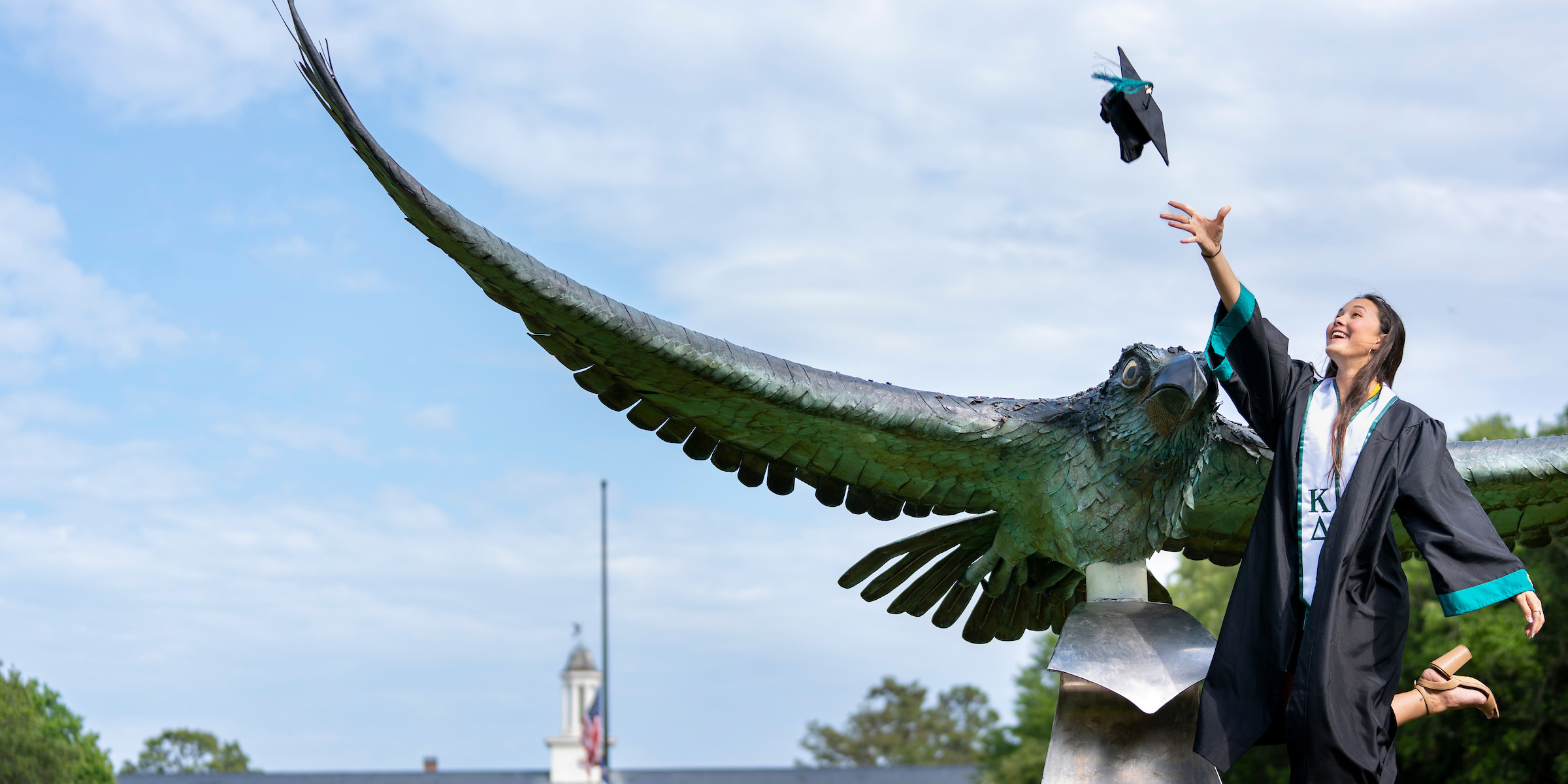
Today, you can find the Seahawk in a place of honor at the Warwick Center, a significant hub of student activity. This beautiful sculpture was given to the university by the Residence Hall Association and was dedicated in the spring of 1999. Tradition maintains that rubbing the talon of the Seahawk will bring you good luck. .
University Colors
The school colors were established in 1947 by the students of Wilmington College. A contest was held to pick the original colors with the prize being $5 for the winning submission. Ludie Croom won the prize and recognition for his recommendation of green and gold as the colors that would stand for Wilmington College and UNCW for years to come.
Green was representative of the Atlantic Ocean that graces our coastal location. Gold was selected to reflect the aura of the lovely sandy beaches indicative of the region. These colors would be worn proudly for years by students, athletes, faculty, staff, alumni and fans.
In 1992, navy was added to the school colors as an accent to distinguish UNCW from other schools in the athletic arena that had the identical colors. The original green has evolved to a softer shade of teal and the gold has moved to a lighter shade of yellow.
Proud Seahawks and fans continue to wear these colors that represent this great institution known as UNCW.
Academic Regalia
The academic regalia usually recognizes three different academic degrees: the bachelor, the master and the doctor. The name of each degree was derived by medieval university custom.
The
bachelor’s degree, or baccalaureate, takes its name from the medieval
practice of “bachelors” wearing a garland of bayberries. The
master’s degree was equivalent to a license to teach and sometimes
was followed by the express words “Licentia Docendi.” The
doctor’s degree, when earned by study, as is true of the Doctor
of Philosophy degree, indicates advanced study and independent research
in a specialized field of learning, whereas honorary degrees are granted
for meritorious service and for distinction in public or private endeavor.
In the medieval university, students and teachers wore gowns indicating
their status and scholastic achievement.
Those holding a bachelor’s degree wear a gown of worsted material, fastened at the top, and distinguished by long pointed sleeves hanging nearly to the knees. The master’s gown, worn open, has long closed sleeves with an arc of a circle appearing near the bottom of a slit for the arm near the middle of the sleeves. The doctor’s gown, also worn open, is faced with a broad strip of velvet and has three bars of velvet on each sleeve.
A hood may be worn with the gown. The bachelor’s hood is three feet long, with a two-inch strip of velvet; the master’s hood is three and one-half feet long, faced with a three-inch strip of velvet; the doctor’s hood is four feet long and faced with a five-inch strip of velvet. The color of the tassel or the velvet strip on the hood indicates the field of study in which the degree was earned or granted; for example: Arts, white; Science, yellow; Education, light blue; Nursing, apricot; Business, drab. Each hood is also lined in silk with the colors of the institution which granted the degree. UNCW’s hood is lined with green and gold.The appropriate cap for all degrees is the familiar black “mortarboard.” A black tassel, or one of the colors signifying the field of specialization, hanging to the left of the face, is appropriate for all degrees. Those holding a doctor’s degree may wear a soft velvet cap of the color indicating their field of study or the “mortarboard” with a tassel in whole or in part of gold thread.
The bell used in the Installation Ceremony is the original hand bell from the Isaac Bear public school building that served generations of students in New Hanover County. In 1947, this building became the first home for Wilmington College. After moving to the current campus the historical ties were continued in 1972 when a new campus classroom building was named Isaac Bear Hall.
Faculty information
Staff Information
Alma Mater
Hail we proudly sing to thee who guides our green and
gold.
Though future years may part us, fond memories we shall hold.
For our hearts will cherish all your service done
All hail to thee alma mater Praise Wilmington.
Here we stand as one together voices raised in song.
Our loyal hearts praise thee as God doth lead us on.
Clock Tower
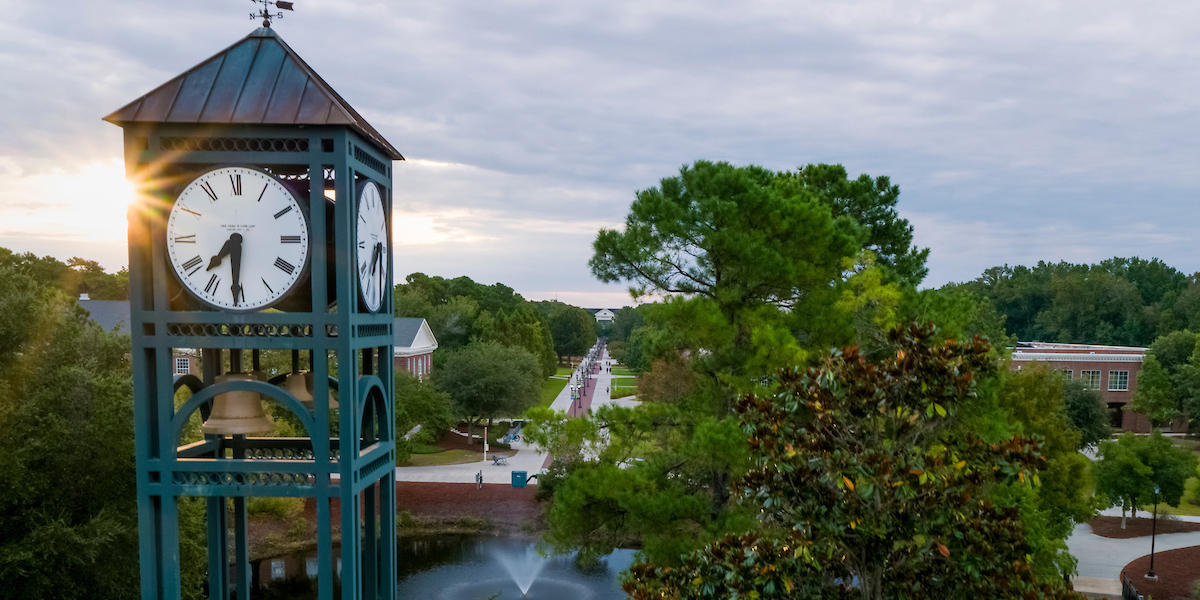
A
recent addition to the UNCW landscape is the clock tower that dominates
the Campus Commons. A gift of the Class of 2000, the idea of erecting
a clock tower was conceived and spearheaded by Shane Fernando, who was
senior class president at the time.
Students, alumni, staff, faculty and community members and businesses contributed toward the final financial goal to make this monumental task a reality. The 50-foot clock tower was dedicated and sounded for the first time at the senior celebration on May 12, 2000. The alma mater plays on the carillon each day at noon and 5 p.m. and the Westminster Chimes toll on the hour.The clock tower has also become a significant part of important institutional events such as the memorial programs for those who died on Sept. 11, 2001, with its ability to play other songs such as the national anthem. Its importance as one of our community’s landmarks continues to grow.
About this Site | Copyright Notice |