
UNCW Home

Watson School of Education Logo


NCQuest Logo Go to NCQuest Math spacer
Go to NCQuest Mentoring Go to NCQuest Science

News & Announcements


Michelle Hafey, an NC QUEST alumna, shares her informative portfolio with current NC QUEST participants.


Technology was used to its maximum by David Childers of cohort II when presenting his portfolio to the group.


Diane Calhoun assists Chynthia Siddons during TaskStream training and the discussion board activity.


Brianne Hoff and Mary Sparks work with instructor on setting the study group meeting schedule to discuss their selected topics of weather and evolution.


Faye Nelson of Brunswick County Schools and Walt Gray of Pender County Schools enjoy the institute and take the time to learn from each other along the way.


Dr. Rich Huber observes as his students, Brianne Hoff and Liz Crace, both of New Hanover County Schools become comfortable with TaskStream.


Jeff Ertzberger, emerging technology lecturer, verifies Dr. Rich Huber's work at the computer.


NC QUEST’s Math and Science Professional Development Network Holds its Winter Institute for Teachers

On February 25 -26 NC QUEST’s Cohort III came together at the Watson School of Education for a two-day educational event where they met with instructional staff, professors, and fellow participants. Cohort III is the third group that is sponsored by NC QUEST, a jointly sponsored program between the UNCW’s Watson School of Education, the College of Arts and Sciences and coalition partner school districts in Southeastern North Carolina. Cohort III consists of seven participants who either have a focus in math or science; the group is comprised of teachers from three partnership counties; Brunswick, New Hanover, and Pender.


The science teacher participants are: Liz Crace, Williston Middle, Brianne Hoff, Murray Middle, Nancy Keith, Cape Fear Middle / West Pender Middle, Chynthia Siddons, Pender High, Mary Sparks, Virginia Williamson, and Rick Thomas, South Brunswick Middle. The lone math participant is Doug Towle from Murray Middle.


NC QUEST is designed to help fulfill the mission of the federal “No Child Left Behind” legislation by assisting middle school math and science teachers in increasing their knowledge in both content and instructional practice, and by increasing the number of skilled mentor teachers to promote teacher development and retention.


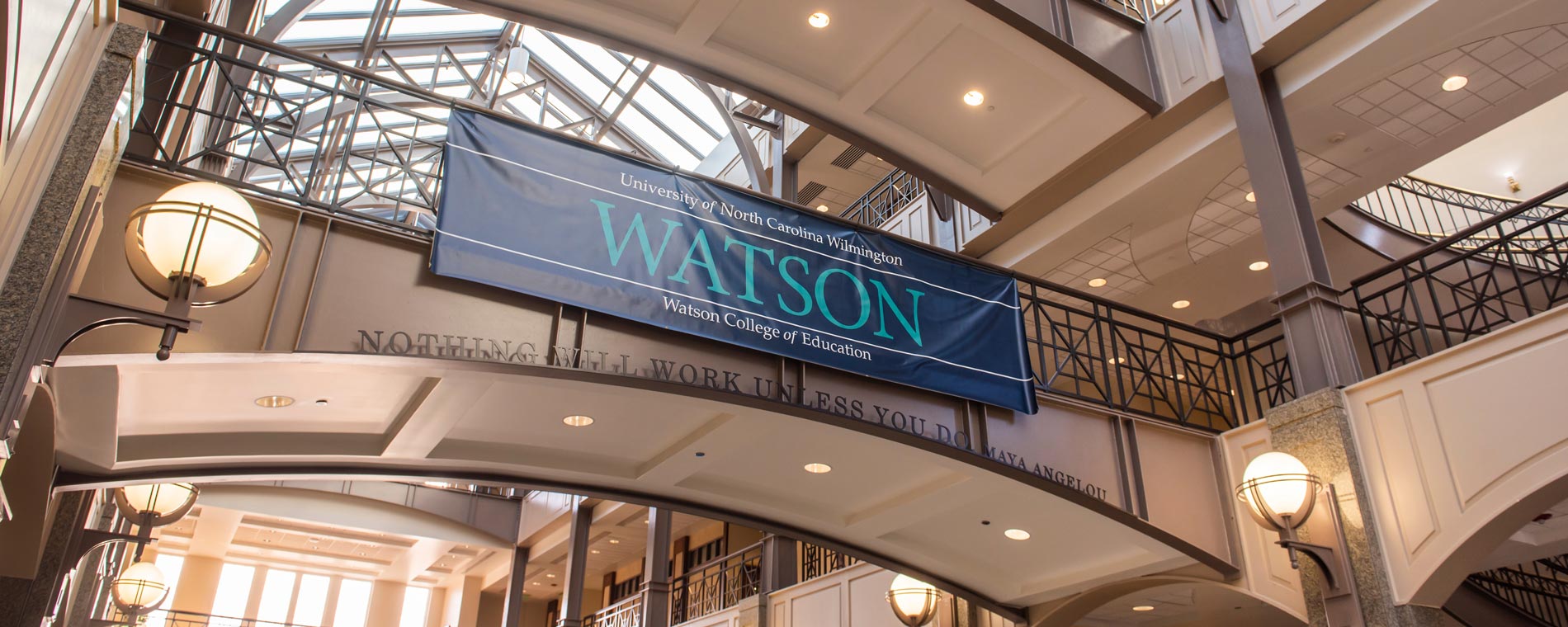
The Winter Institute commenced with a warm welcome from Dr. Cathy Barlow, Dean of the Watson School of Education. In her welcome, Dr. Barlow pointed out some of the unique characteristics of the lovely new education building and the N.C. Teacher’s Legacy Hall, which was created to honor teachers across the state. Special kiosk’s line the main hall and recognize our state’s teachers and principals of the year, display tools for teaching, a school bus display with bench seats, and generous donors who brought this dream to fruition. This sampling of Legacy Hall is just that, a hint at the hall’s beauty.


The coordinator for Professional Development at the UNC Center for School Leadership Development in Chapel Hill, Dr. Karen Gerringer, was there to openly express her welcome to the students and to share the high esteem that exists between her office, the Watson School of Education and the NC QUEST Program. UNCW has demonstrated its commitment to the program and was recently awarded an additional NC QUEST grant, “Coalitions 4 Success” which will run through September 2006.


There was an overview of the NC QUEST course and an introduction of the project directors and instructional team. The project directors are Dr. Karen Wetherill and Dr. Ron Sizemore. The project instructional leader is Pat Smith and Sherry Broome serves as the evaluator. The mentoring instructor who works with this cohort’s study groups is Diane Calhoun. Marty Sugerik serves as the math instructor and Dr. Rich Huber works with the science students. Graduate assistants supporting the office and work of this cohort are Marty Link and Jennifer Barber.


In mid-morning, Diane Calhoun divided the participants into groups where they discussed building their capacities as teachers by using study groups and to discuss the importance of teacher’s participation in personal self-assessment and reflection. The key capacities for increasing quality instructional effectiveness that were presented, reviewed and evaluated were: Teacher as Assessor of learning, Teacher as Instructional Leader/Facilitator, Teacher as Collegial Partner, Teacher as Learner and Self-Assessor, Teacher as Reflective Practitioner and Decision Maker, Teacher as Inquirer and Researcher, Teacher as User of Technology Tools and Teacher as Content Master and Teacher as Challenger for Learning. Each participant reflected, responded in writing, verbally shared their thoughts with the group and created their own plans for growth in these areas. Responses will be compiled and compared at the end of the course for assessment of their areas of success and those needing continued personal work.


Dr. Rich Huber and Marty Sugerik met with the participants and presented to them an overview of the math and science strands, the syllabi and the independent study model being used this semester. In the science lab, Dr. Huber explained the constructivist approach to teaching, using classroom activities for the group to tackle. This inquiry based learning/teaching philosophy has relevance for all learners. It uses the premise that all participants are given the opportunity to actively make sense of their own personal experiences and are encouraged to find meaning and leaning through their unique mental processes. Institute activities reinforced this type of learning.


Dr. Rich Huber and Marty Sugerik also gave the participants a review of the national standards for math and science, which they were able to correlate with relative math and science discussion topics. Liz Crace, a science teacher, volunteered to participate during a math demonstration using TI-85 calculators to show the group an inquiry lesson using slope.


An overview of the final portfolio assignment and the rubric for the constructivist approach to assessment was presented by Diane Calhoun. The cohort was eager to learn about this aspect of the course and then have it actively demonstrated by recent alumni of the NC QUEST.


Michelle Hafey, a science teacher at Penderlea School in Pender County and David Childers, a math teacher at Union Middle School in Sampson County, spoke about their experiences in NC Quest Cohort II during the fall of 2004. They presented their portfolios to the newest group who will be working to develop theirs on line for their May 9 celebration event. Both former NC QUEST students portfolios were enjoyed by all.


On Saturday, Cohort III met for the second day of the 2005 Winter Institute. After breakfast, the group went to the educational technology lab where Jeff Ertzberger, Emerging Technology Lecturer, guided the group through Taskstream training. Taskstream is a program where teachers can create and share lesson plans, view the standard course of study, and participate in online discussions about interesting educational topics. Dr.Huber, Marty and Diane then guided Cohort III in their first group discussion board on Constructivism while using Taskstream.


After a salad sampler lunch, Diane Calhoun spoke about collaborative analysis of the student work in middle grades, student work analysis, and the study group process. Three study groups were created by content emphasis. Liz Crace and Brianne Hoff chose to study evolution and Nancy Keith, Chynthia Siddons, and Rick Thomas elected to study water quality. Mary Sparks chose to study weather and Doug Towle is working with Marty on his area of emphasis for middle school math. Before the 2005 Winter Institute came to a close, the participants were given assignments; set meeting times for their study groups and made individual instructional appointments.


The instructional staff enjoyed their lively two days with our newest group and wishes Cohort III the best of luck throughout their experience with NC QUEST!


Back to News and Announcements >

Dr. Rich Huber, Dr. Ron Sizemore, Diane Calhoun, Marty Sugerik, Mary Sparks, Brianne Hoff , Doug Towle, Liz Crace, Nancy Keith, Chynthia Siddons, Rick Thomas


Mary Sparks, Nancy Keith and Chynthia Siddons discuss and note teacher key capacities that they plan to build on during NC QUEST.


Dr. Rich Huber demonstrates "the heavy newspaper" science demonstration to the participants.


Marty Sugerik instructs cohort III about the importance of using technology , here with theTI-85 calculator, and the constructivist approach to teaching math.


Dr. Karen Gerringer, Coordinator for Professional Development from the UNC Center for Professional Development in Chapel Hill along with Chynthia Siddons , an NC Quest participant, do an inquiry based science activity.


Marty Sugerik and Doug Towle discuss interesting math topics that will be the focus of Doug's NC QUEST study.


Dr. Ron Sizemore, Rick Thomas and Nancy Keith discuss meeting times for the “water quality” study group of NC QUEST.


If you have any additional informational needs or requests regarding NCQuest at the Watson School of Education
please contact Patricia Smith at (910) 962-3881 or E-mail smithpc@uncw.edu

home | math | science | mentoring
course calendar | resources | taskstream |
news | general information | participant information | instructional team

Back to UNCW | Back to the WSE