

University of North Carolina at Wilmington

Vocal Program Handbook

(2005/6)

I.                    VOCAL PROGRAM MISSION STATEMENT

II.                  MEET THE FACULTY

III.                ADMISSION TO THE UNCW VOCAL PROGRAM

a.      Entrance auditions

b.     Vocal Performance

c.      Reentering students

d.     Requests for applied instructor

IV.               VOICE LESSON ATTENDANCE REGULATIONS AND POLICIES

a.      Scheduling of lesson times

b.     Tardiness

c.      Absences

d.     Make-up lessons

e.      Voice lesson credits, practice time

f.        Repertoire requirements

g.     Masterclass

h.     Tuesday seminar

i.        Vocal coaching

j.        All-Departmental

k.      Concert attendance

l.        Photocopying

V.                 COURTESY AND PROFESSIONALISM

a.      Request for change of applied instructor

VI.               EVALUATION OF STUDENT EFFORT

a.      Jury examinations

b.     Incomplete grade reports

c.      Make-up juries

d.     Upper divisional exams

e.      Evaluative criteria

VII.             ENSEMBLE REQUIREMENTS

VIII.           DEGREE RECITALS

a.      Repertoire requirements

b.     Reserving a date/proposal forms

c.      Recital permission hearings

d.     Dress rehearsals

e.      Grading

IX.               DEGREE REQUIREMENTS

X.                 ADVISING

XI.               OPPORTUNITIES FOR STUDENT PERFORMANCE

XII.             WEB LINKS TO SINGER SITES


I.                    VOCAL PROGRAM MISSION STATEMENT

UNCW provides a holistic approach to teaching, encouraging students to improve not only their voices, but also their musicianship and performance skills. We challenge our singers to find the connection point between the areas of a traditional musical education (theory and history), and the imaginative arena of performance. To help facilitate this journey students meet in master classes several times a week, learning about repertoire, pedagogy, languages, acting, and stage presence. Producing thoughtful, consistent, and imaginative singers is our main goal, and we achieve this through a supportive vocal community.       

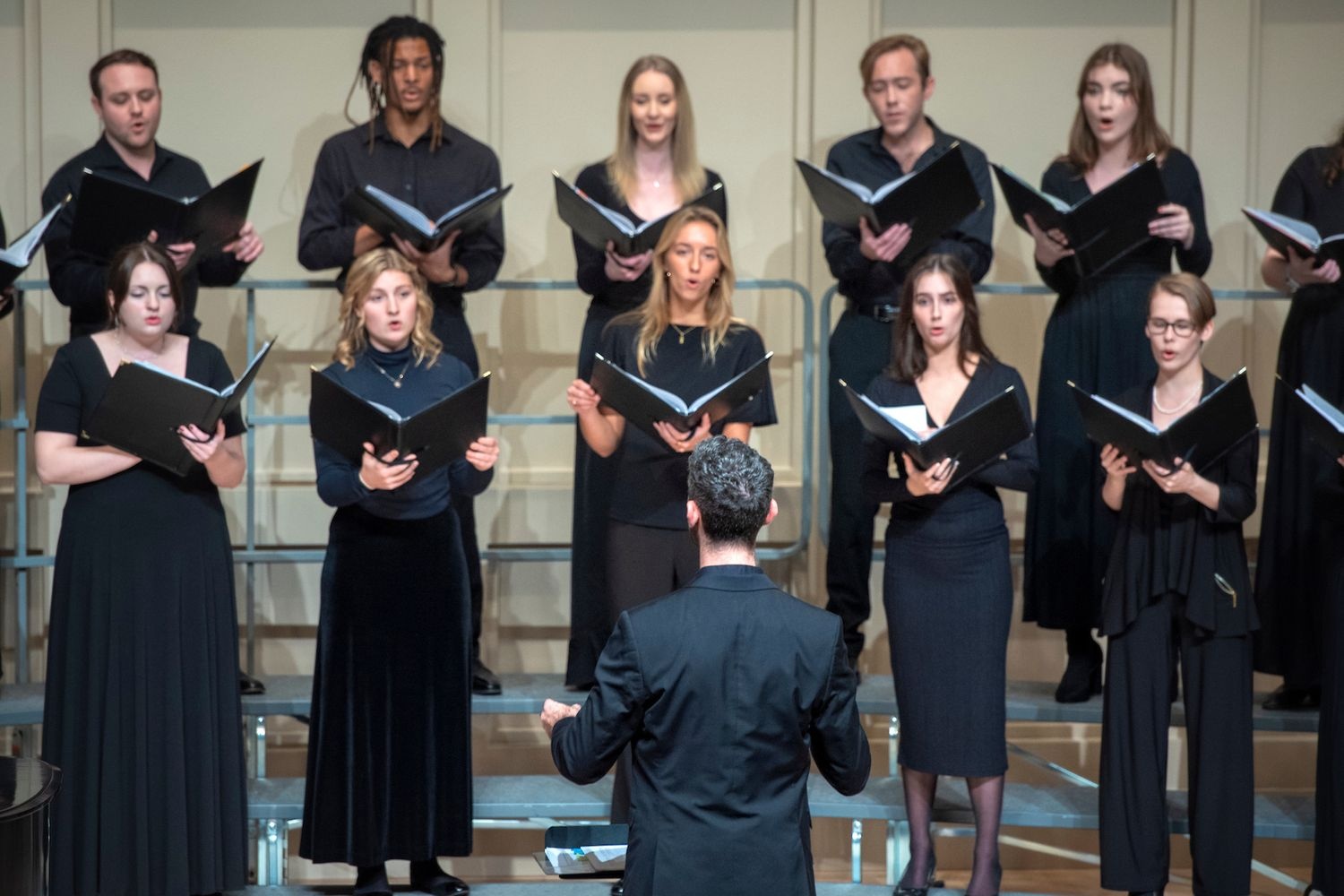
The choral activities program at UNCW is full of opportunities for students.  Repertoire is selected in cooperation with the voice faculty and students are cast in solo roles for choral events.  It is a stated curricular goal that the choral ensembles perform great works in varying styles, from early music to contemporary works, and the ensembles satisfy basic studies arts requirements as well as departmental ensemble requirements.  The groups perform regularly with orchestra.  UNCW music faculty and visiting performers such as the period instrument group Ensemble Courant are frequent additions to choral ensemble concerts.

The staff includes three full-time faculty in vocal and choral music and three part-time faculty who serve as vocal coaches, rehearsal accompanists, and performance associates (piano, harpsichord, and organ with solo voice or with chorus).  Visiting artists are brought to the campus regularly and interact with student performers and/or performing ensembles during their visits.


II.                  MEET THE FACULTY

NANCY KING, soprano

Assistant Professor; Coordinator of Vocal Performance

Canadian soprano, Nancy King, is an active performer, teacher and currently the Coordinator for Vocal Performance at the University of North Carolina at Wilmington.  She is also the Voice Chairperson for the North Carolina Music Teachers Association.

Ms. King holds a Master's Degree in Voice Performance from Boston University and is completing a Doctorate of Musical Arts at the University of Minnesota, where she studies with Jean del Santo.  Well-known to area audiences, Ms. King is a popular guest lecturer, most recently presenting a series of Opera Lectures for The Friends of Southport/Oak Island Library, and various outreach programs as a part of UNC-WOOP! (the newly established UNCW Opera Outreach Project!).  She also presents The Singer’s Workshop: Freeing the Mind, Body and Voice for Optimal Performing, along with pianist Patricia Ainspac and movement instructor, Judith Clinton.  In addition, Ms. King is currently recording with her Duo Sureño partner, Robert Nathanson, guitar, a project that features the world premiere of a commissioned piece by Minnesota composer Christopher Gable. 


Ms. King has most recently appeared with the Wilmington Symphony Orchestra in North Carolina, performing Carl Orff’s Carmina Burana, Barber’s Knoxville: Summer of 1915 and Canteloube’s Chants D’Auvergne.  Other recent performances include Bach’s St. John Passion, the Mozart Vespers and Requiem in Wilmington,NC and Mozart’s Regina Coeli with the UNCW Chamber Choir in Salzburg Austria.  She has also performed the Poulenc Gloria and Handel’s Messiah with the Wilmington Symphony.  While in residency at the University of Minnesota, Ms. King performed the roles of Cunegonde in Candide, Amor in Orfeo ed Euridice with the Opera Theatre, and the Serenade to Music with the University of Minnesota Orchestra.  Ms. King also won the Voices of Vienna Scholarship, for study at the Mozarteum Sommerakademie in Salzburg, Austria, and received a UNCW Center for Teaching Excellence Summer Teaching Initiative Stipend for her project “Italian Language and Opera Study” in Florence, Italy this past June.  She has also attended the Wesley Balk Opera/Music Theater Institute, the Phyllis Curtin Seminar at Tanglewood, and has participated in master classes with Sylvia Olden-Lee, Martin Issep, Nico Castel, Lois Marshall, and 20th century specialist, Jane Manning. Ms. King is also a tenured member of the Oregon Bach Festival Chorus, under the direction of Helmuth Rilling. 

JOE HICKMAN, tenor

Associate Professor; Coordinator of Choral Studies

Dr. Joe Hickman is director of the University Concert Choir and Chamber Singers groups. The University choirs have toured extensively both in the United States and in Western Europe. Dr. Hickman also writes choral reviews and articles for the Choral Journal and has a number of scholarly performing editions published with Masterworks Press of Olympia, Washington.


PATRICIA AINSPAC, vocal coach and pianist

Patricia Ainspac is a graduate of the Juilliard School of Music and the recipient of a Fulbright fellowship to study accompanying at the Academy of Music in Vienna, Austria.  She was the accompanist for the New York Concert Choir, directed by Margaret Hillis, and the American Opera Society of New York City.  She has worked with such well-known singers as Eileen Farrell, Marilyn Horne and Leontyne Price.  Ms. Ainspac taught at the Henry Street Music School in New York City and the Conservatory of Music in Santo Domingo, Dominican Republic.  She recently joined the music faculty at the University of North Carolina at Wilmington and also serves as choir director for the Unity Christ Church in Wilmington.


III.                ADMISSION TO THE UNCW VOCAL PROGRAM

a.   Entrance Auditions

Every student who wishes to enter a degree program in voice must successfully pass an audition for entrance into the Department of Music.  Entrance auditions are scheduled at designated times throughout the year for voice majors.  Contact the music office for more information regarding actual dates and sign-up procedures.  Elective students must also sing an audition to determine placement with an instructor or voice class.

Acceptance into the degree program does not guarantee the completion of the degree.

Throughout the course of vocal study, the student must successfully pass jury examinations, upper divisional exams, and recital hearings.  If a student’s performance does not meet the expected standards of the voice faculty in these examinations, the student will be placed on probation and/or advised to seek another major area of study.

b.  Vocal Performance

Students may audition for the Vocal Performance track after completing one year of study in the Music Department.  This is a rigorous program, dedicated to excellence in the field of singing-acting.  Students accepted into this program will possess outstanding skills in the areas of vocal technique, dramatic interpretation, language facility, musicianship, coupled with a strong work ethic.  Students completing this degree should expect to continue their studies in graduate school, or in apprenticeship with an opera company.

Vocal Performance majors must maintain a high level of excellence in every area of vocal study to remain viable in their degree track.  Failure to do so may result in the removal from the program.  A student who is removed from the program will then be   required to re-audition; re-acceptance will be at the discretion of the voice faculty.

c.   Reentering Students

Any voice major who has not been enrolled for one semester of credit based vocal instruction at UNCW will be required to re-audition for entrance into the program.  This audition must be arranged in consultation with Coordinator of Vocal Performance, Nancy King.

d.   Request for an applied instructor

If a student wishes to study with a particular instructor, he/she may request that instructor by listing the professor’s name on the entrance audition form or permission to register form.  Every effort will be made to honor these requests.  It is advisable for the student to speak with an instructor well in advance of the school year to determine if the desired instructor has available space for the student in his/her load.  If no instructor preference has been indicated on the audition form, the student will be assigned an instructor by the Coordinator of Vocal Performance.

IV.               LESSON ATTENDANCE REGULATIONS AND POLICIES

a.   Scheduling of a lesson time

It is the student’s responsibility to contact their instructor on or before the first day of class to schedule a lesson (instructors typically post available lesson times on their studio door).  Lessons begin on the first day of classes.  Failure to sign up for a lesson time during the first week results in the forfeiture of that lesson. Upper level students: please be sure that your lesson time doesn’t conflict with another student’s vocal coaching time. 

b.   Tardiness

Ten minutes is the minimum waiting time before either party may forfeit the lesson.  The instructor is under no obligation to make up the lesson or the time missed if the student is tardy.  If the instructor is tardy, he/she will make up the time missed or schedule a make-up lesson.

c.   Absences

Your lesson time is a weekly appointment specifically reserved by the professor to work with you.  Therefore, great care and consideration must be exercised before requesting a cancellation of any lesson! Your instructor must be notified 24 hours in advance of an absence in order for that absence to be excused.  Legitimate reasons for canceling a voice lesson are illness and/or personal/family emergency.  The voice faculty is under no obligation to make up lessons that the student cancels.  Therefore, it is in your best interest to switch lesson times with one of your colleagues rather than cancel a lesson.

Any lesson at which a student fails to appear without giving prior notification to the instructor is an unexcused absence.  It will be counted against the student’s grade (see instructor syllabus for specific guidelines regarding absences).  Four unexcused absences in any semester will be cause for the student to be removed from the studio and the voice department.

d.   Make-up lessons

Make-up lessons are given at the discretion of the faculty member.  They are scheduled when conflicting professional commitments require a faculty member to postpone a student’s lesson.  Failure to show up for a scheduled make-up lesson results in a failing grade for that lesson.

e.   Voice credits/practice time

Bachelor of Music Education:                196/396—2 credits (hour lesson/week)

BM in Vocal Performance:                     197/397—3 credits (hour lesson/week)

Bachelor of Arts/Music Minor:               195/395—1 credit  (half hour lesson/week)

Minimum practice time for a 1 credit (half hour) student should be 5 hours/week.  Students registered for 196/397 should be spending 7 hours/week on vocal study.  Vocal performance students and others registered for 197/397 should be spending at least 12-15 hours/week on vocal study.  These are minimum requirements; more is expected for students preparing recitals, competitions, and auditions.

Your practice time should be divided among vocalization, musical and textual analysis, translation, memorization, rehearsal with your accompanist and listening to various recordings of your assigned repertoire.  All voice lessons must be recorded.

f.    Repertoire Requirements

Selection of repertoire is left to the discretion of the instructor and geared to the ability of the student.  All students will be required to learn repertoire in a variety of languages and stylistic periods.  Minimum requirements are as follows:

Bachelor of Music Ed.                8 songs/semester                 Junior Recital

BM Vocal Performance              10 songs/semester               Junior and Senior Recital

BA; Music Minor; Elective          5 songs/semester                 No recital

g.   Masterclass

All students registered for 196/396 and 197/397 are required to attend weekly masterclasses (Upper Level: M 4:00-5:30, Lower Level: R 4:00-5:30).  Students will be graded for their effort in this class; consult syllabus for specific requirements.  Any students enrolled in 195/395 are welcome to audit these classes.


h.   Tuesday Seminar

All students registered for 196/396 and 197/397 are required to attend Tuesday Seminar.  This is a performance class, and each student is required to sing each week.  If you are unable to perform due to illness, please notify your teacher.  You are still required to attend class and sit at the back, unless you provide a doctor’s note. 

i.    Vocal Coaching

Students studying voice at the Upper Level are given a weekly half-hour vocal coaching by Pat Ainspac.  Students presenting a recital in any given semester will receive an hour coaching per week, and will also have our coach-accompanist play their lessons.  Vocal coachings are graded on the same scale as voice lessons, and are subject to the same attendance rules.  All vocal coachings must be recorded.

j.    Concert Attendance

All music majors will be required to attend at least eight concerts every semester in which they are enrolled in applied lessons. These eight concerts may be chosen from UNCW student, solo and Artist Recital Series, the Wilmington Symphony Orchestra series, the Wilmington Concert Association series, the North Carolina Symphony series, or others approved by individual instructors. Students may apply no more than two concerts in which they participate as a performer towards the eight required concerts. Concert attendance verification is determined by the applied professor and will be recorded at the end of each semester on the student’s final Jury Form by the applied instructor. Attendance will be reflected in the final grades of studio courses, as well as other classes in which concert attendance is a part of the course requirements.  Voice students are required to attend the Junior and Senior Recitals of their colleagues (dates will be provided at the beginning of the semester, so please make appropriate arrangements).

k.   All Departmental

The last Tuesday of each month is a joint recital by all the music students.  Voice students are required to perform on these recitals at least once per semester.  The voice faculty chooses students and repertoire for these recitals.  Students are required to provide a poetic translation for their song, due to the Coordinator of Vocal Performance (Nancy King) the Friday before the recital.  Translations should be typed out with the foreign language first (complete text with diacritical marks inserted) followed by the English translation, and e-mailed to Prof. King <kingn@uncwil.edu>.  Students who fail to provide a written translation will be required to give a verbal translation prior to their performance.


l.    Photocopying

Federal copyright laws protect composer's and publisher's rights against illegal photocopying. UNCW voice faculty supports these laws by encouraging students to build their own personal music libraries by systematically purchasing legal copies of music in the standard repertoire for their voice types. Questions concerning the legality of photocopying under extenuating circumstances should be directed to the department chair. Use of photocopies or other reproductions of music under protection by copyright laws will not be tolerated in juries or public performance.


V.                 Courtesy and Professionalism

Professors are people too, and like to be treated with the same courtesy and consideration that you do.  A few simple reminders will help build a stronger and more professional relationship with your professor:

a.      If you are ill or unable to sing, please cancel your lesson.  Stay out of your teacher’s studio.  Your teacher is a performer too, and has no desire to catch whatever illness you may have!

b.      Be respectful.  Address your instructor by his/her last name unless permitted to do otherwise.

c.      Have an understanding regarding your teacher’s policy for entering the studio, especially when another student’s lesson is in progress.

d.      Be prompt and prepared for your lesson.  This shows respect not only for your teacher but also for yourself as an aspiring professional.  You must gain and maintain your teacher’s respect in the same way that he/she must maintain respect for you.

e.      If you have a misunderstanding with your professor, speak to him/her about it directly.  It takes two people to build any good relationship, and you, the student, are part of the solution.  An honest and respectful dialogue will help maintain a good professional and personal relationship.

f.        Since your performances in public are a reflection of your teacher and the UNCW Vocal Program, it is a matter of courtesy to inform your teacher well in advance of any solo performances on or off campus. 

a.         Request for change of applied instructor

When an instructor accepts a student into his/her studio, he/she is making a strong commitment to that student.  It is the responsibility of the professor to guide the student in a realistic direction, to be honest with the student about the individual’s talent and professional goals as well as to provide vocal instruction.  In most cases, the relationship you have with your vocal instructor is one that will last for your entire length of study at the University.  The commitment that an applied instructor makes to a student should not be taken lightly.  Whether or not it appears so to you, your teacher is always acting in your best interest, according to his/her level of professional expertise.

Occasionally, either one or both parties may decide it would be better for the student to study with a different instructor.  If the student is seeking a change of instructor, he/she must speak first with the current teacher and inform him/her of the intent to change studios.  The following form must be completed by the student and the current instructor before the student makes arrangements to study with another faculty member.  A copy signed by you and your present instructor must be presented to your desired instructor.  This form will become part of your student file.


REQUEST FOR CHANGE OF APPLIED INSTRUCTOR


I.                    This form confirms that I have spoken to my present vocal instructor concerning my desire to study in another studio, and am now free to seek another applied instructor.


Signature of student: ____________________________________________

Signature of present instructor: ___________________________________

Date: ____________________

Comments:


II.                  Signature of new instructor: _______________________________________

Date: ____________________

Comments:


III.                Final Approval by Coordinator of Vocal Performance:

Signature: _____________________________________________________

Date: ____________________


VI.               EVALUATION OF STUDENT EFFORT

a.   Jury Examinations

Every student is required to sing a jury at the end of each semester of study.  To reserve a jury time, students must sign the jury schedule form, available on Prof. King’s studio door (KE 109D) two weeks before the end of the semesters.  Juries are graded by a three member faculty committee, and last for 10-15 minutes, depending on the student’s level of study.

A student does not have to sing a jury in a semester which he/she sings a degree recital.

b.   Incomplete grade reports

Students may submit a written request for an incomplete grade report to the voice faculty for the following reasons:

I.                     Illness at the time of the jury.  A written doctor’s excuse should accompany the request.

II.                   A significant professional performance or major vocal competition off campus.  This request should be made early in the semester.

III.                  A personal/family emergency, serious illness or death of a family member during the scheduled jury dates.

IV.               Fewer than 10 lessons during the semester due to illness or injury.  A physician’s written excuse is required.

c.   Make-up juries

Make-up juries are scheduled the first Thursday of the following semester, at 2pm. (In cases of extreme illness or emergency, a student may petition the faculty for an extension).  All juries must be made up by the fifth week of the following semester.

d.   Upper divisional jury exams

To ensure that the quality of your performance meets the standards set by the voice faculty, upper divisional exams are scheduled for any student who is progressing to a higher level of study.  Upon successful completion of the upper divisional jury, the registrations number for the individual’s voice lessons changes (although the number of credits remains the same).


e.   Evaluative criteria

The following chart includes the criteria that the voice faculty considers in the determination of your grade.  Student effort is evaluated in every area: voice lesson, vocal coaching, masterclass, Tuesday seminar, and voice jury.  Please note that attendance, preparation and participation are also included in your grades.  Weekly grades are available to students upon request, and students will be notified of their current grade standing during mid-semester evaluation.

`


Category


EXCEEDS THE

SET EXPECTATION                  4


MEETS THE

SET EXPECTATION         3


APPROACHES THE

SET EXPECTATION                 2


DOES NOT MEET THE

SET EXPECTATION               1                                         


PRACTICE JOURNAL


-provides insightful commentary above the set expectations

-evidence of practicing more than the required amount per week

-daily record of length of practice, what and how you practiced, and any problems encountered

-5 x 45 minutes/week

-occasional entries of length of practice, and what and how you practiced

- less than 5 sessions per week

-no evidence of practice


EFFORT IN

VOICE LESSON


-comes to lesson with specific musical and technical difficulties addressed; sings with an understanding of the poetry/dramatic elements

-has listened to/read about song

-song/role study sheet prepared, and all musical aspects of the song learned

-teacher’s suggestions should be integrated by the next lesson

-partially completed song/role study sheet, some aspects of the song learned

-shows little integration of teacher suggestions

-inconsistent effort, no evidence of independent learning, no attempt to integrate teacher suggestions


EFFORT IN

COACHING


-able to read the text dramatically, with attention to word stress; shows artistic development of musical aspects of the song (word stress, color changes, emotional attitudes)

-has listened to/read about song

-able to read text with understanding; thorough preparation of the musical aspects of the song

-coach’s suggestions should be integrated by the next lesson

-pronunciation is inconsistent, little understanding of the text; incorrect rhythms/pitches

-inability to integrate coach’s suggestions

-inconsistent effort, no evidence of independent learning, no attempt to integrate coach suggestions


MASTERCLASS

PARTICIPATION


-performance shows artistic/technical  development; great attention to phrasing and emotional attitudes; offers an individual interpretation of song

-memorization of song; dramatic and technical suggestions integrated; willingness to try and make class suggestions

-song not fully memorized; dramatic and technical suggestions not integrated; not willing to try class suggestions, and inability to offer comments

-inconsistent effort, no evidence of integration of suggestions; unwillingness to participate in class


EFFORT IN

VOICE SEMINAR

-completely memorized: no pitch/rhythm/word mistakes; total emotional connection/dramatic expression; appropriate attire & stage deportment; paraphrase foreign song texts

-memorization of song;  no stops; occasional creative words; one noticeable mistake (pitch/rhythm); clear dramatic expression; appropriate attire & stage deportment; paraphrase foreign song texts

-no more than two obvious stops; noticeable pitch/rhythm mistakes; minimal dramatic expression; inappropriate attire & stage deportment; inability to paraphrase foreign song texts

-cannot perform song from memory; incorrect pitches/rhythm; no dramatic expression; inappropriate attire & stage deportment; inability to paraphrase foreign song texts

Voice Lesson Grading Ranges:


Grade                     Grade Points                       

A                             3.9—4.0  Excellent

A-                            3.6—3.8                 

B+                            3.1—3.5

B                              2.9—3.0  Good

B-                            2.6—2.8                 

C+                            2.1—2.5

Grade                     Grade Points                       

C                              1.9—2.0  Average

C-                            1.6—1.8                 

D+                            1.1—1.5

D                              0.9—1.0

D-                            0.6—0.8  Passing

F                              0.5—0.0  Failure


VII.             ENSEMBLE REQUIREMENTS

Voice majors must participate in a choral ensemble every semester they are registered for voice lessons.  Students must audition for Chamber Singers (see Dr. Hickman).  Students failing to register for an ensemble will be re