Budget Summaries
Multi-Year Budget Summaries
UNC Wilmington FY27 Budget Summary
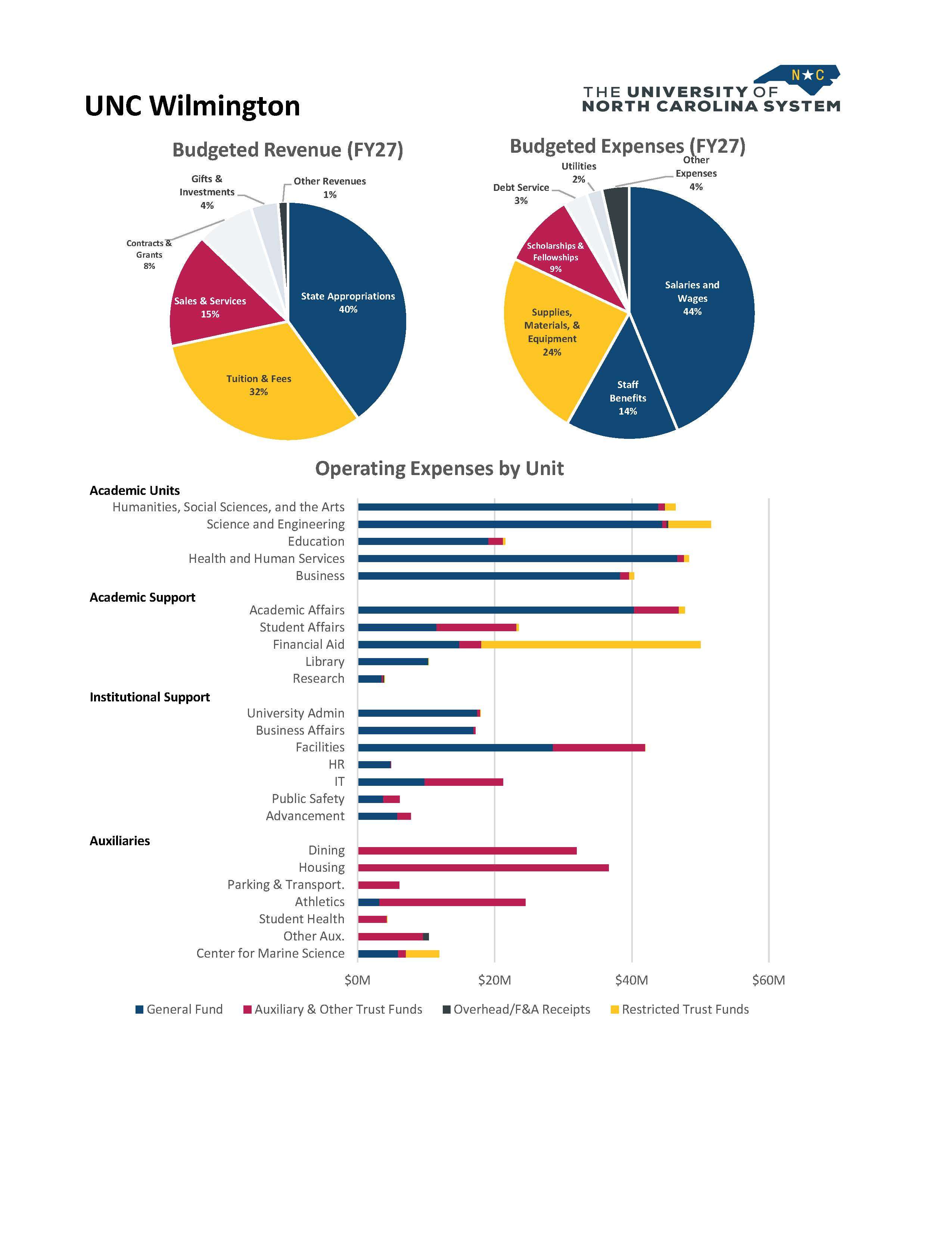
The University of North Carolina Wilmington’s FY27 All-Funds Budget reflects a disciplined, data-informed approach to resource allocation that aligns with UNC System priorities while advancing the institution’s academic mission. The budget builds on a demonstrated record of operational efficiency and strong student outcomes, while making targeted investments necessary to support sustained enrollment demand, workforce-aligned academic programs, and student success.
UNCW continues to operate as one of the most efficient institutions within its peer group, with comparatively low education and general expenditures per student and per degree and strong performance on key student success indicators. Accordingly, the FY27 budget is not designed to address structural inefficiencies, but to preserve and scale a model already delivering strong outcomes. Within this context, the University is making targeted recurring investments across core academic, student success, and operational priorities while maintaining operating flexibility to align instructional capacity with final enrollment outcomes.
Strategic Resource Realignment
The FY27 budget reflects deliberate alignment of resources to institutional and UNC System priorities, with investments organized across four areas: (1) Academic Growth and Program Delivery; (2) Student Lifecycle (Enrollment and Success); (3) Workforce and Talent Strategy; and (4)Operations and Core Infrastructure.
A significant portion of new resources is directed toward academic capacity and program delivery in high-demand, workforce-aligned disciplines. Investments in faculty hiring and instruction are tied to sustained student credit hour demand and are essential to maintaining course availability, optimizing class section offerings, reducing time to degree, and supporting continued progress on graduation and degree efficiency metrics. Additional investments support program growth in areas of sustained demand, including business and nursing, which are critical to meeting regional and statewide workforce needs.
Investments in the student lifecycle support both access and outcomes. Expanded advising capacity, academic support services, and enrollment infrastructure are designed to improve persistence, progression, and completion. These investments align directly with UNC System performance metrics related to retention, graduation rates, and degree efficiency.
Student Affordability
UNCW remains committed to maintaining affordability while delivering high-quality academic programs. The FY27 budget reflects this commitment through both direct financial support and continued cost discipline.
The University is increasing need-based financial aid by approximately $855,000 on a recurring basis, ensuring that aid scales with enrollment and tuition revenue. This supports students with demonstrated financial need while helping to mitigate increases in borrowing.
UNCW’s cost structure also contributes to affordability. The University delivers strong outcomes at a relatively low cost per student and per degree. Investments in advising, course availability, and academic support further reduce excess credit accumulation and extended time to degree – two primary drivers of total student cost.
Financial Sustainability
The FY27 budget reflects a structurally balanced plan grounded in disciplined governance and resource prioritization, with recurring resources allocated through a structured framework that prioritizes mandatory obligations, prior commitments, and the highest-impact institutional needs.
The budget includes targeted investments in workforce and talent strategy, including $1.5 million to address market and compression pressures in critical roles. It also addresses core operating needs –
including utilities, insurance, technology systems, facilities maintenance, and campus safety –
to ensure that the University’s infrastructure remains capable of supporting continued academic and enrollment activity.
The University has maintained a measured level of operating flexibility within the FY27 plan to allow for final alignment of faculty hiring, course section offerings, and instructional delivery with actual enrollment outcomes. This flexibility enables adjustments to sections, instructional capacity, and faculty deployment as enrollment is finalized and is necessary to manage a demand-driven academic model.
Enrollment Funding Risk
The FY27 financial plan is significantly dependent on enrollment-related state appropriations that have not yet been finalized through the legislative process. These funds represent a substantial portion of the recurring resources required to support the University’s academic and operational plan.
The impact of not receiving this appropriation would be immediate and consequential. These resources are directly tied to the University’s ability to scale academic programs aligned with workforce needs, expand instructional capacity, and sustain student support infrastructure necessary to drive retention and degree completion.
Given the University’s current operating posture, there is limited capacity to absorb a material shortfall without direct impact to core academic and student success functions. Planned investments are concentrated in faculty hiring, course delivery, advising, and essential infrastructure – areas fundamental to maintaining course access, minimizing time to degree, and supporting student outcomes.
If enrollment funding is not fully appropriated, the University will be required to take immediate actions to realign expenditures. These would include delaying or reducing hiring, limiting course section availability, scaling back program delivery in high-demand disciplines, and deferring critical operational investments. Such adjustments would directly impact the University’s ability to meet student demand, support timely degree completion, and respond to workforce needs across the state.
While the University has maintained limited flexibility to manage short-term uncertainty, that flexibility is not sufficient to offset a sustained funding gap of this magnitude. The realization of enrollment funding is therefore critical to execution of the FY27 financial plan.
Budget Snapshot
UNC Wilmington FY26 Budget Summary
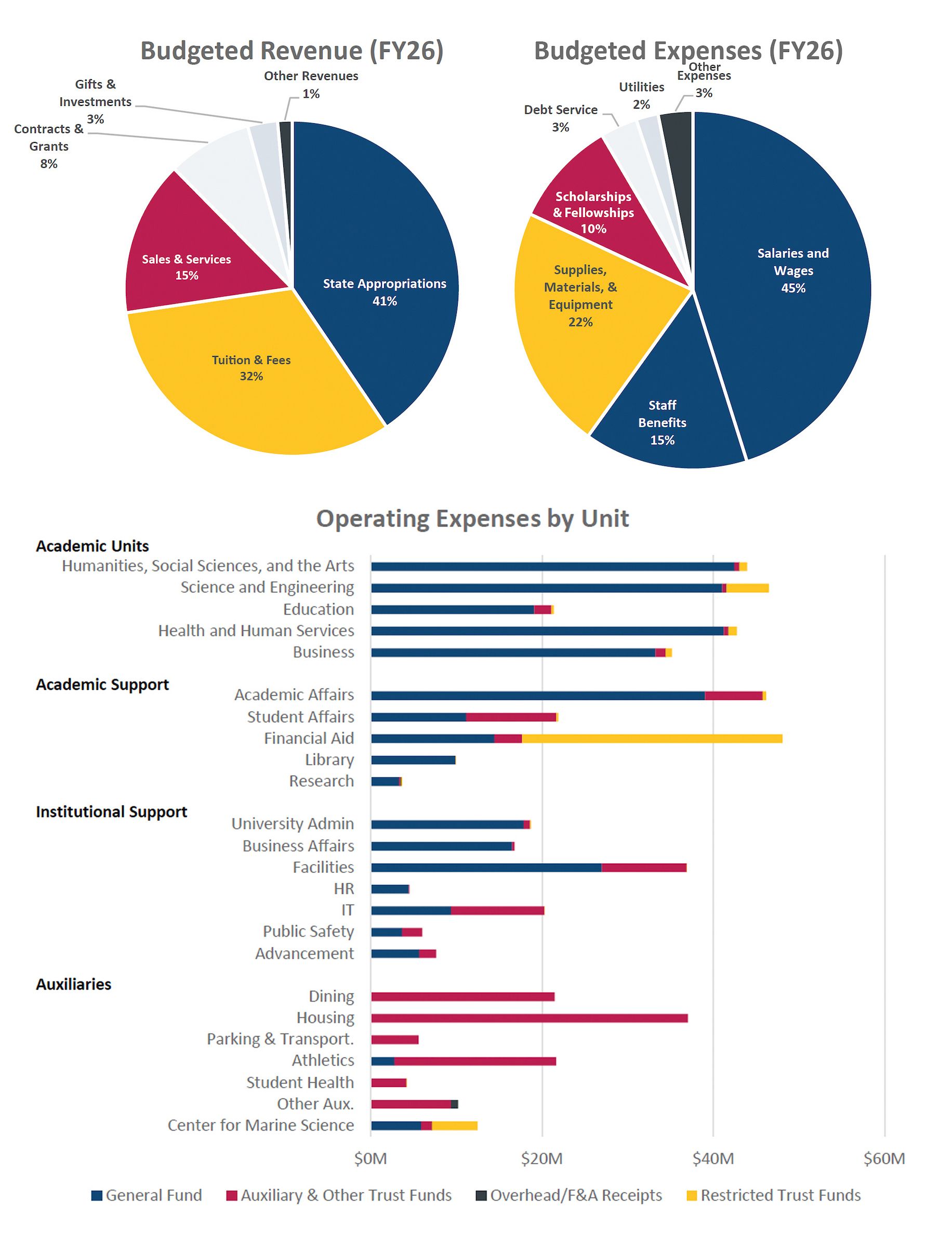
Through the FY26 All Funds Budgeting process, the University of North Carolina Wilmington will make meaningful investments that support system-wide strategic objectives along with priorities identified in UNCW's strategic plan.
The budget was further informed by an institutional commitment to providing students and taxpayers with an incredible value proposition, which matches accessibility and affordability with high-quality academic programs to ensure graduates are prepared to meet North Carolina's workforce needs and realize long-term career success. Finally, the FY26 budget also reflects UNCW's commitment to disciplined financial planning, which ensures the financial stability and sustainability of the University and each of its component units. A summary of how the FY26 budget supports the aforementioned objectives is outlined below.
Strategic Alignment
To support UNCW's improvement with respect to UNC System performance metrics and progress towards objectives outlined in UNCW's new strategic plan, the FY26 budget provides additional investments in a variety of programs and areas that are essential for attracting, serving, and retaining students, and helping to ensure their success post-graduation. These new investments include, but are not limited to:
- Academic Advising: Effective academic advising directly supports students in setting clear academic objectives, enrolling strategically in courses, and proactively addressing academic challenges. As a result, in FY26, UNCW will be investing an additional
$651,000 to hire up to nine additional full-time academic advisors. This targeted investment will expand our advising capacity, ensuring all undergraduate students consistently receive personalized guidance from professional or faculty advisors, ultimately enhancing their ability to complete degrees on schedule and advancing UNCW's performance on key UNC System metrics.
- High-ROI Academic Programs: Recognizing the UNC System's emphasis on providing a strong return on investment (ROI) for students and taxpayers of North Carolina, UNCW is allocating over $4 million to support new faculty hires and instruction across a number of disciplines that exhibit strong demand and/or directly address the workforce needs of our state and Specific programs receiving support through this allocation include, but are not limited to: Accounting, Business Analytics, Coastal Engineering, Cybersecurity, Data Science, Information Systems, Nursing, and Supply Chain Management.
- Student Support Services: Recognizing the direct linkage between student support services and student outcomes, UNCW is making notable investments in critical student support service units. Specifically, the FY26 budget will invest approximately $270,000 to address staffing needs in the Disability Resource Center, which offers students tailored academic testing and accommodation solutions. In addition, $168,000 will be provided to the University Learning Center to expand tutoring and structured study sessions for students across various disciplines. Collectively, these initiatives help reduce drop, fail, and withdrawal incidents for students and maintain progress towards their respective
Access and Affordability
UNCW remains deeply committed to student access and affordability, demonstrated by continued progress on each of the UNC System performance metrics related to student debt. To build upon this progress, the FY26 budget includes targeted investments in key areas, including:
- Student Aid: An additional recurring investment of $760,000 will scale UNCW's need- based financial aid to better meet the needs of our This enhanced support will reduce the amount resident students need to borrow, maintaining accessibility and affordability for students with demonstrated financial need.
- Student Employment: UNCW will expand on-campus student employment opportunities in critical areas, including tutors in the University Learning Center and Resident Assistant roles within Housing and Residence Life. Additionally, the Career Center which provides career counseling and facilitates off-campus work opportunities/paid internships, will receive additional funding to help scale applicable services and better support the needs of These opportunities not only reduce students' reliance on loans but also provide valuable career experience beneficial after graduation.
- Maintaining Progress to Degree: To further reduce the cost burden on students, UNCW will invest over $400,000 to strengthen summer instruction offerings, particularly targeting courses with historically high DFW (Drop/Fail/Withdrawal) rates that can delay timely graduation. By facilitating smoother and quicker paths to degree completion, these investments help students avoid the added financial burdens and lost earning potential associated with extended enrollment periods.
Financial Sustainability
UNCW continues to employ internal review and reallocation processes to ensure financially sound and sustainable operations. This is evidenced by a major campuswide reallocation of more than $2 million in recurring funds implemented in FY24, achieved by rightsizing budgets in units experiencing declining enrollment, consolidating overlapping services, and realigning staff workloads.
This focus continued in the development of the FY26 budget, as the Provost, CFO, and applicable deans reviewed SCH production and workload ratios for each academic department and used this information to inform many of the strategic investments outlined in the previous sections. In addition, similar screening and review processes were employed for applicable trust and auxiliary operations and used to develop individual operating budgets for each unit for the upcoming fiscal year.
Conclusion
UNCW's FY26 budget reflects a strong alignment between resources and results. It builds on the University's momentum in improving student outcomes, invests in strategic academic priorities with proven workforce relevance, and reinforces the institution's commitment to fiscal discipline and operational excellence. By aligning financial decisions with UNC System goals and the campus mission, UNCW is well-positioned to continue delivering strong value for students, families, and the citizens of North Carolina.
Budget Snapshot
UNC Wilmington FY25 Budget Summary
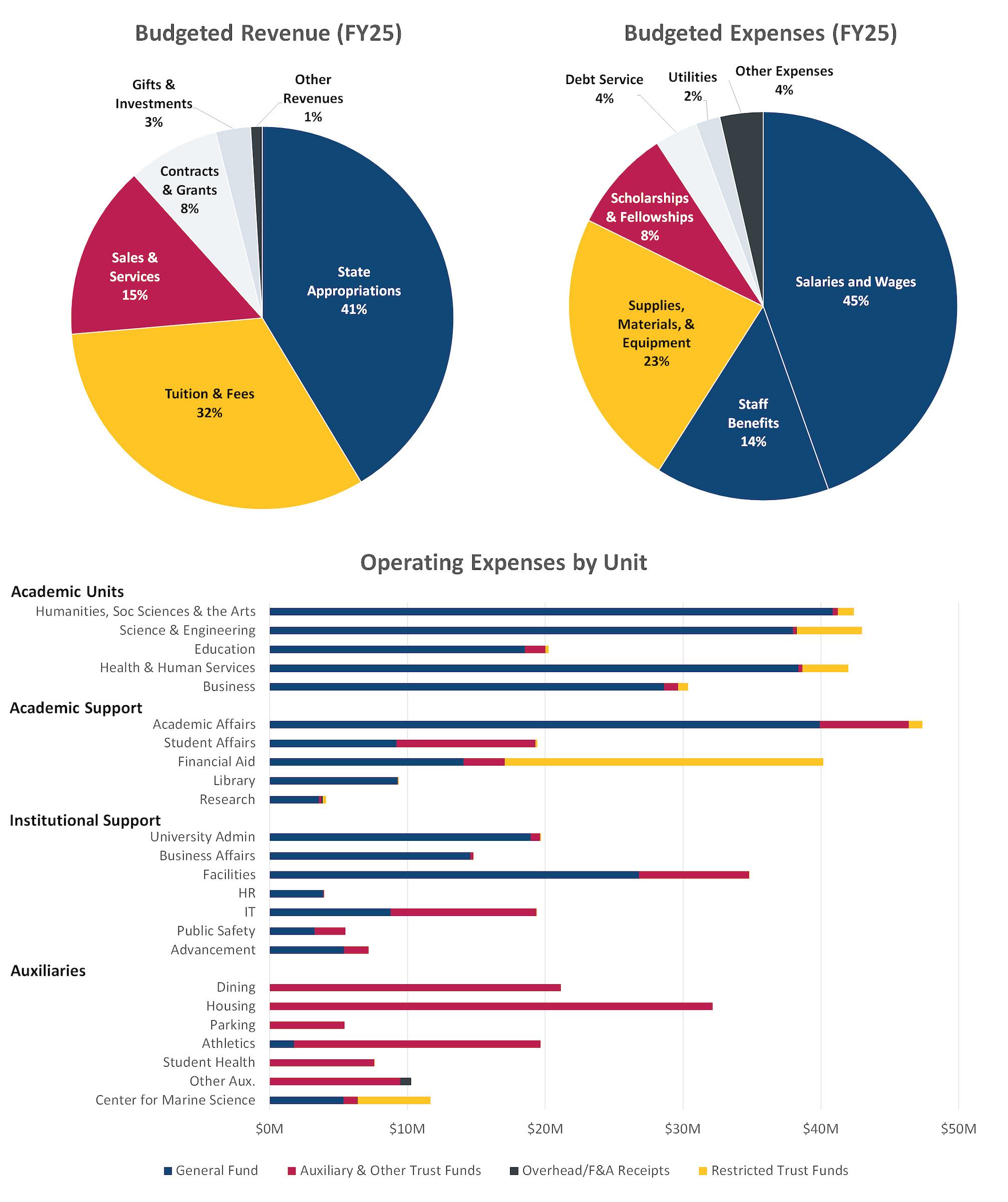
Through the FY 24-25 All Funds Budgeting process, the University of North Carolina Wilmington crafted a budget aimed at bolstering both system-wide strategic objectives and priorities identified in UNCW's new strategic plan. The budget was further informed by an institutional commitment to efficient operations and financial plans which are sustainable and responsive to enterprise risks.
Examples of how UNCW's budget supports system-wide strategic objectives and campus-specific strategic plan priorities is summarized below.
UNC System Performance Goals
UNCW has been successful in exceeding system stretch goals pertaining to: First Time Student Debt, Transfer Student Debt, and Masters Degree Efficiency. 1 In addition, in FY 24-25 UNCW will receive a performance-weighted appropriation related to the Education and Related Expense per Degree metric, which recognizes the progress UNCW has made relative to the applicable 2020 baseline. 2 While UNCW's score pursuant to the Undergraduate Degree Efficiency indicator decreased modestly from the base year, at 28 it remains among the best in the system.
New Investments re: Performance Goals & UNCW's New Strategic Plan
To support UNCW's improvement in the aforementioned metrics, and progress towards objectives outlined in UNCW's new strategic plan, the budget provides additional investments in a variety of programs/areas which are essential for attracting, serving and retaining students and helping to ensure their success. New investments include, but are not limited to:
- Academic Advising: Academic advising is essential to ensuring students make informed academic decisions, fulfill their academic aspirations, and progress towards degree completion in a timely As a result, over $1 million in new funding will be invested to hire up to 12 additional academic advisors and ensure all UG students have a professional advisor and/or faculty advisor assigned to them throughout their time at UNCW.
- Disability Resource Center: As the number of students registering with/utilizing DRC services has increased significantly in recent years, so too have the staffing demands being placed on the center. As a result, the budget provides over $300k to support four additional staff positions for the These positions will ensure UNCW's students continue to have appropriate access to the DRC services even as demand continues to increase.
- Facilities Staffing and Master Plan Implementation: Over the past five years, significant expansion of campus facilities along with the increasing complexity of building systems has created a pressing need for more facilities staff, especially in roles such as maintenance technicians, environmental technicians, housekeepers, and facility engineers. Additionally, with a number of major renovation projects on the horizon, there is a necessity to hire additional project management staff to handle the growing Consequently, UNCW plans to allocate over $1.1 million in FY 24-25 to boost staffing levels and meet these demands.
- Financial Aid: Additional permanent investments of $750k will be used to appropriately scale the campus's need-based aid budget to its growing student body and to enable UNCW to remain accessible and affordable to students with demonstrated need. As a result, these investments should inversely impact the amount of debt that resident students need to incur to attend UNCW.
- Interactive Learning and Research Opportunities: UNCW has identified $2.6 million to significantly enhance/expand research and applied learning opportunities for its By integrating both applied learning and research involvement into their education, students can greatly enhance their academic experience and improve their prospects for future employment or further study. Further, SGA leadership has identified the expansion of research opportunities for students as one of their top priorities for the upcoming year.
- Market Salary Pool: To address the specific needs within our workforce and retain talented faculty and staff, UNCW has set aside up to $1.9 million for targeted discretionary salary adjustments, which are separate and discreet from the legislative increases anticipated in FY 24-25. This fund is not intended for across-the-board raises but is designed for strategic use where it is most needed (particularly in areas where market pressures are most acute).
- Mental Health Services: Demand for mental health services has increased significantly in recent years, while simultaneously the market for recruiting/retaining care providers has become more competitive. To respond to this challenge, UNCW will be providing the counseling center with approximately $800k in new funding in FY 24-25 to support the hiring of additional clinical care providers and peer educators; and to make the market salary adjustments needed to fill vacant positions and retain existing care providers.
- Student Employees and Graduate Assistants: Through mandatory fee adjustments, additional funding is being provided to increase wages for students working in campus recreation. On- campus employment not only reduces the need for students to borrow, it also is considered a high-impact practice that aids in student retention, persistence, and graduation. In addition, up to $850k in general funds has been set aside to better align graduate stipends with current market rates. This will allow UNCW to recruit top-tier graduate assistants (which enhances the quality of applicable programs and the experience for all students).
1 Performance outcomes reflect scores calculated to create UNCW's performance-based appropriation for FY 24-25.
2 While UNCW did not meet its stretch goal pertaining to Ed and Related Expense per Degree, at $46,279 per degree awarded, UNCW remains among the most efficient in the system with respect to this particular metric.
3The November 2023 study (available here) indicated that UNCW provides the highest Incremental Lifetime Earnings per Incremental State Dollar invested of any campus in the UNC System.
New Investments re. ROI Study & UNCW's New Strategic Plan
UNCW values the UNC System's focus on providing a strong return on investment (ROI) for applicable students and the taxpayers of North Carolina. To maintain UNCW's trajectory of success which was reflected in the ROI study released late last year 3, the university intends to invest more than $1.2 million in FY 24-25 for developing and scaling academic programs which prepare the workforce for high demand occupations. Specific programs slated to receive said support in FY 24- 25 include, but are not limited to: Master of Healthcare Administration, B.S. in Cybersecurity, and B.S. in Intelligent Systems Engineering.
Additional Budget Considerations
UNCW has intentionally increased service, supplies, materials, and equipment expense budgets to account for inflationary pressures experienced in previous years, and that are anticipated to continue (albeit at a slower pace) in FY25. In addition, the university has proactively set aside resources to help address needs and strategic opportunities we anticipate beyond FY25, and also to be prepared for potential revenue volatility as we plan for the future.
Budget Snapshot