

Where Science Meets the Sea: UNCW Program Immerses Teens in Marine Research
Courtesy: Lauren Tippett
For many teens, summer means a family vacation and their first job. Through UNCW, summer offers aspiring marine scientists an immersive, deep dive into the field.
For more than 45 years, MarineQuest, the official marine science outreach program for UNCW, the Watson College of Education and the Center for Marine Science, has provided marine and environmental science enrichment programs for children and teens.
Through Oceans 17, MQ’s capstone program, participants conduct lab and field-based research alongside UNCW marine science faculty, staff and graduate students, mastering scientific techniques, such as GIS mapping and quantitative data analysis.
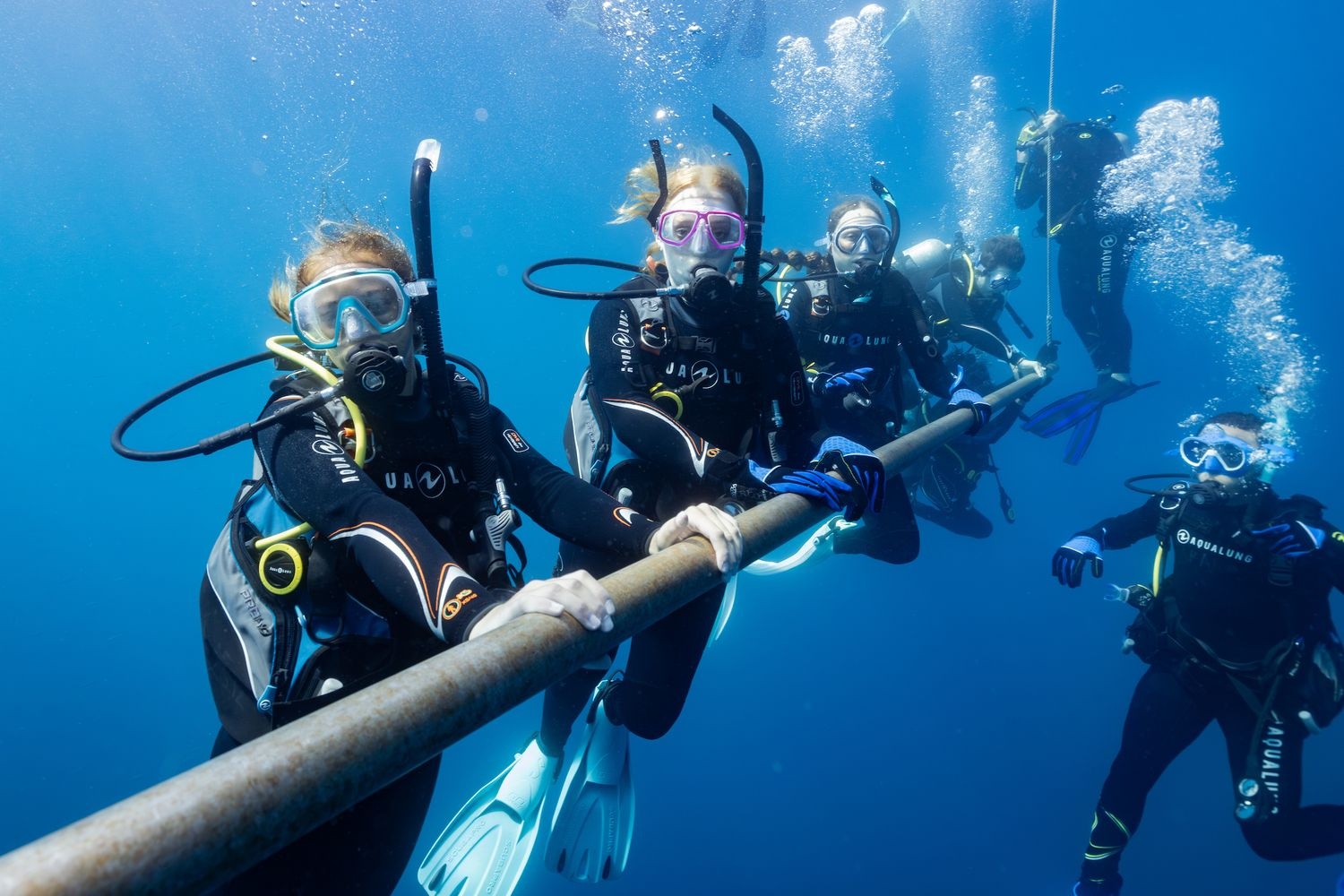
Beyond the lab, students train and earn their Advanced Open Water SCUBA Certification, better preparing them for underwater data collection.
“What truly makes O17 special is the combination of SCUBA and authentic research opportunities that allow students to contribute to meaningful scientific work,” said Harris Muhlstein ’04, ’10M, MQ’s school program coordinator and a UNCW marine biology graduate. “We have worked to refine it over the years to be a one-of-a-kind marine science experience for rising high school seniors.”
A small percentage of O17 graduates are invited to participate in The Sea Scholars Program, a competitive leadership and research skills development opportunity. Sea Scholars spend three weeks on campus as part of the MQ summer educational team, working as counselors-in-training, and spending time in the lab or the field assisting with research. The lab they are placed in is one of the research collaborators from their O17 experience.
Marine biology major Aidan Leahy ’29 is a current Sea Scholar who participated in O17 as a high schooler.
“This program showed me what it means to study marine science and made me even more excited to pursue a degree in marine biology,” he said. “Most students don’t get to do DNA extractions, micro-pipetting and dissections until their junior year. O17 introduced me to a lab that I’m now working for which has given me an amazing start to my professional career.”
Leahy is working in the lab of UNCW Assistant Professor of Biology and Marine Biology Bradley Tolar, who has been involved with O17 for the past three summers. Research in his lab focuses on Archaea, the third Domain of Life, which he describes to students as “like bacteria but different.”
Tolar is thrilled to have Leahy working in his lab. “In the summer of 2025, right before his freshman year at UNCW, he helped us collect samples and run experiments with the next O17 group and contributed to research in my lab. He enjoyed it enough to join my lab as an undergraduate researcher and has worked with us ever since,” he said. “We have been able to let him work on our TEAL-SHIPS project, and he presented this work at a regional conference in Morehead City, NC, as well as at the UNCW CSURF symposium in April.”
Leahy recommends O17 to anyone interested in studying marine science. “It will teach you what that actually means and set you up for immediate success,” he said.
Tolar is grateful to MQ and O17 for giving young scientists realistic career experience through field, laboratory work and computational analysis, and is excited for future collaborations.