

UNCW Students Help Safeguard Veterans Memorial Reef
Coastal engineering students use wave-flume testing to help ensure the long-term stability of an underwater memorial honoring veterans.
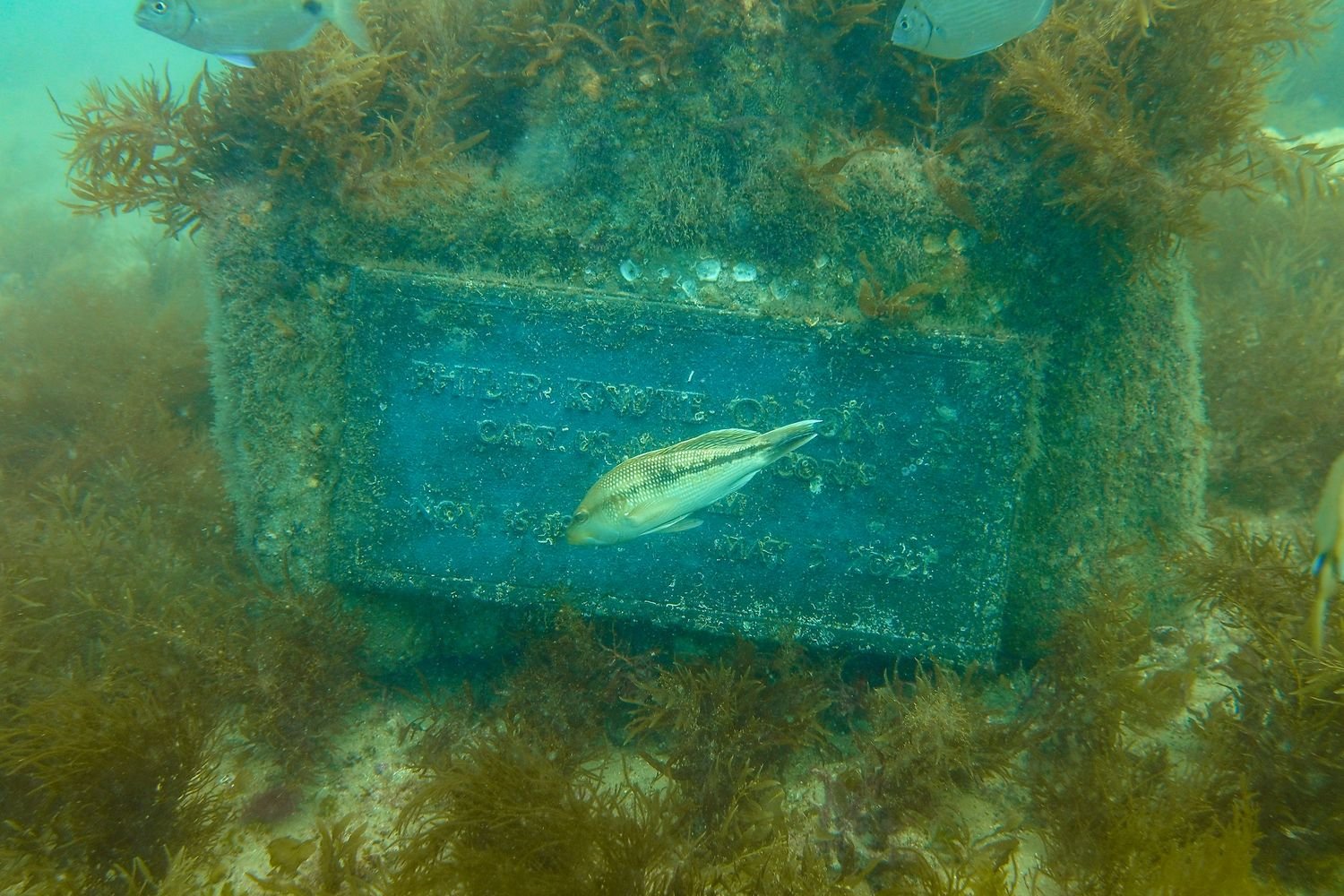
Courtesy: Vivian Yuditsky/Veterans Memorial Reef
About five miles off the coast of Wrightsville Beach, a unique underwater memorial is taking shape. The Veterans Memorial Reef serves as a marine habitat and a final resting place for veterans. Ensuring the artificial reef can withstand waves, currents and storms has become an important challenge, one that a team of UNCW coastal engineering students recently tackled through their senior capstone project.
For Skylar Hinnant, Stephanie Spranger, Lucy Patterson and August Taber, the Veterans Memorial Reef project stood out among several potential capstone opportunities because it combined meaningful community impact with complex engineering questions. The average depth of the memorial reef is about 50 feet, meaning most of the research must be done without physically visiting the site.
“This is not just a ‘place-it-and-leave-it' reef but requires organized planning and layouts and monitoring to ensure that the intended locations and stability endure,” said Greg Williams, a coastal engineering assistant professor.
Veterans Memorial Reef officials wanted UNCW researchers to determine whether the structures could be stacked and arranged in different configurations while remaining stable over time. To answer those questions, the student team turned to one of the coastal engineering program’s most valuable research tools: the wave flume. Using more than a decade of offshore wave data collected near the reef site, the students recreated scaled versions of real-world storm conditions in a controlled laboratory environment.
The process required careful modeling. Students generated wave conditions based on historical extreme events and monitored how miniature reef replicas responded. Throughout testing, they collected data on wave heights, wave periods, water velocities and reef movement while using cameras to document the structures' behavior from multiple angles.
“To become established as an active ecosystem, it is important that the VMR reefs remain stationary,” said Hinnant. “Understanding wave-induced velocities at the project site will help determine the placement, design dimensions and anchoring of the reefs.”
The project was not without challenges. Creating accurate small-scale versions of the uniquely designed memorial units proved difficult, as did recreating conditions found at the reef's approximately 50-foot-deep offshore location — all inside a laboratory tank containing only a few feet of water.
“The project involved a lot of trial and error where we would try something, run into a problem, and then rethink our approach,” said Spranger. “It gave us a much greater appreciation for the technical challenges involved in both physical and numerical modeling, while also teaching us how to work through data gaps, unexpected lab issues, and other challenges that arose throughout the project.”
By identifying configurations that are better able to withstand extreme conditions, future memorial units may be placed in ways that improve the reef's long-term resilience and stability, said Spanger and Hinnett.
“One important aspect of research is identifying ‘What’s next?’ or ‘Where do we go from here?’ Their work sets a foundation for future researchers to build upon what they did,” said Williams. “Their work pays it forward to another group of students while also honoring veterans.”
Vivian Yuditsky, Veterans Memorial Reef media coordinator, said the student researchers are helping to build a scientific foundation for the future of the reef.
“Our relationship with UNCW represents something we deeply believe in: when education, scientific research and community service come together, we can create a lasting impact,” said Yuditsky. “We are proud to work with students and faculty who are helping us understand how our veterans’ memorials can continue benefiting our ocean for generations. Together, we are helping ensure that their legacy of service continues long into the future.”
For Hinnant and Spranger, the experience also expanded their understanding of what coastal engineering can accomplish.
“This project helped me realize how rewarding it is to work on projects that are larger than yourself,” Hinnant said. “I intend to work on projects similar to this one that heavily benefit others.”