


Expanding Horizons Through Global Business
Courtesy: UNCW
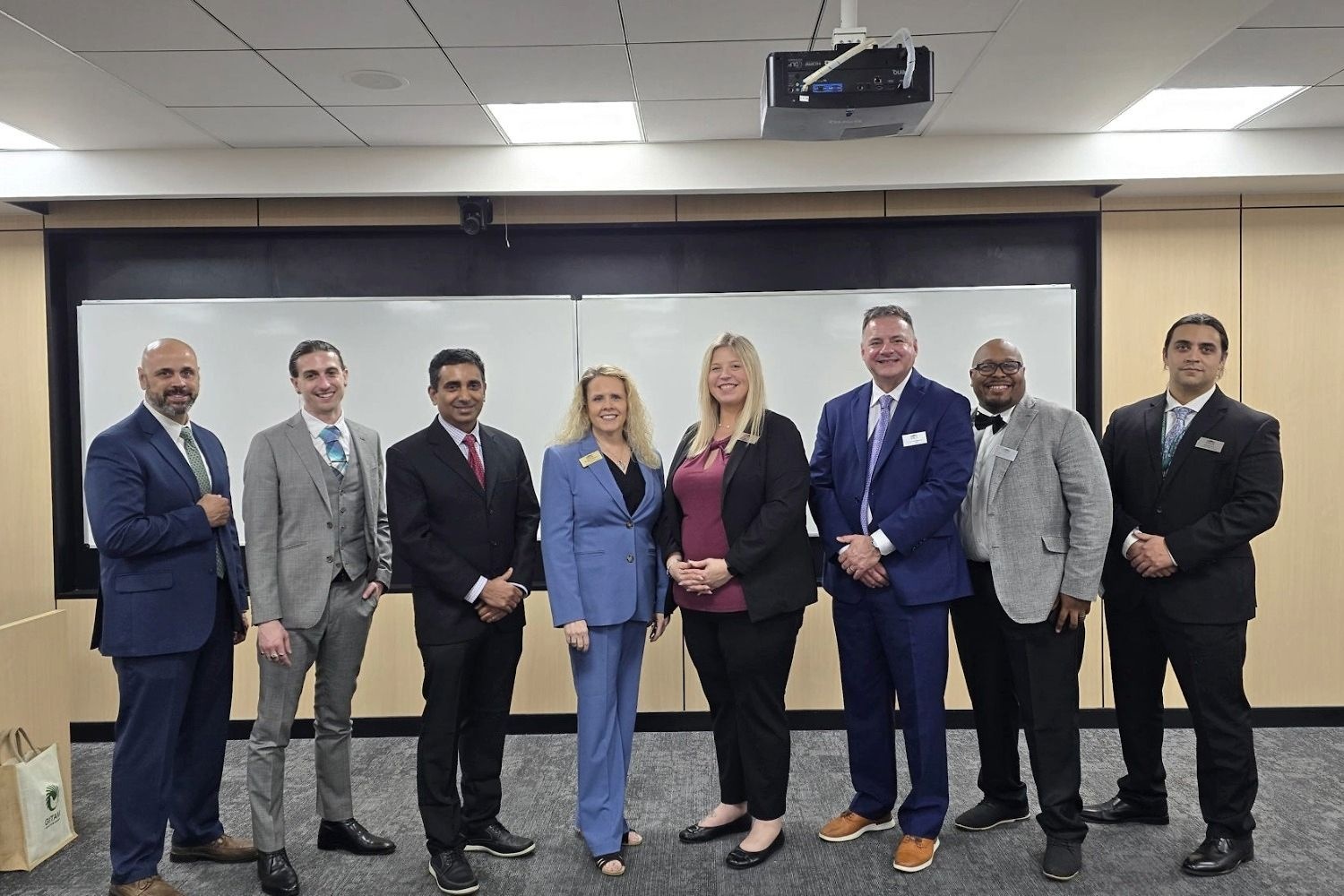
For Executive MBA students in the Cameron School of Business, the global consultancy experience is designed to do more than broaden resumes — it reshapes how students see the world, their work and their own potential. With support from generous donors, six students traveled to India, where they collaborated across cultures, tackled complex business challenges and gained firsthand insight into a rapidly evolving global market. For Cameron Calhoun ’27 and Randy Young ’27, the experience became a defining chapter in careers already marked by ambition, resilience and reinvention.
Calhoun arrived in the program as a seasoned entrepreneur, but one who still believed in pushing beyond his comfort zone. Raised on a farm in eastern North Carolina, his business instincts developed early — from working tobacco fields to launching a small-scale agricultural venture with his brother that quickly outpaced hourly wages. Over time, those instincts evolved into building and selling multiple companies, from diagnostic imaging centers across the Gulf South to a Wilmington-based recycling operation and, most recently, a tech startup aimed at transforming the moving industry.
Yet Calhoun’s decision to pursue an Executive MBA was sparked not in a boardroom, but in a basketball arena. After being challenged by his children to model lifelong learning, Calhoun enrolled at UNCW — and soon found himself considering an opportunity he initially resisted. “I said, ‘I’m not coming to India, why would I?’” Calhoun recalled. But curiosity won out.
What followed was an immersive experience that blended classroom rigor with real-world complexity. Partnering with students from Gandhi Institute of Technology and Management (GITAM) University, Calhoun’s team worked on a consulting project within the tire industry, analyzing market dynamics in a rapidly evolving economy. The immersion of the trip extended beyond infrastructure to industry. Site visits — from a high-efficiency shrimp processing facility to an integrated medical innovation hub — challenged assumptions and revealed the scale and speed of global supply chains. “It changed my perspective,” Calhoun said. “I always thought imported shrimp hurt local fishermen, but the reality is we couldn’t meet demand without it.”
For Calhoun, the greatest value came from stretching his thinking. Coordinating across time zones, collaborating with international peers and navigating unfamiliar systems forced him to operate differently.
“If you want to grow, you’ve got to get uncomfortable, you can’t expand if you stay in a box.”
For Young, the journey to India was decades in the making. A senior director at Blue Cross Shield of North Carolina, Young entered the Executive MBA program with a clear purpose: to stay competitive in a rapidly changing workforce and to invest in his own long-term growth. But India represented something more personal.
Early in his career, Young worked alongside colleagues from India while based at the World Trade Center, even teaching himself conversational Hindi. “I always wanted to go and try my Hindi out in the motherland,” Young said. “Fast-forward 25 years later, I finally got that opportunity.”
Like Calhoun, Young’s experience blended professional challenges with cultural discovery. His team’s consulting engagement required navigating incomplete data, complex market dynamics and cross-cultural collaboration. Working with younger students from India introduced an unexpected leadership challenge. “By default, they would naturally agree to whatever we were saying,” Young explained. “We had to tell them, ‘We’re making suggestions, not giving instruction.’ Once we did that, the team dynamic shifted.’”
The project itself pushed students to think strategically about global markets. While analyzing a major international brand’s position in India, Young uncovered a key insight: brand dominance does not translate universally. “I assumed it was as strong there as it is here,” Young said. “It’s not even top five.” Instead, local brands hold stronger cultural relevance — a lesson in the importance of localization in global strategy.
For both students, the experience reinforced the value of global exposure, not as a resume boost but as a mindset shift. Young left with a renewed professional goal:
“I absolutely have a goal now to work at a company that gives me an international perspective.”
Calhoun, meanwhile, returned with new ideas, new connections and a broader lens for identifying opportunities.
Both are quick to point out that the experience would not have been possible without donor support. “It helped alleviate some of the financial burden and made this life-changing experience possible,” Young said. For him, the opportunity carried an even deeper meaning. “This trip was 25 years in the making for me,” Young added. “I knew I would gain something that would transcend my life.”
Calhoun echoed that gratitude, emphasizing the broader ripple effect of experiences like this. “You don’t always realize the impact, but it really does take stress off students,” Calhoun said. “These experiences change lives, and those people go on to change other lives.”