

Two UNCW Researchers Selected for Prestigious NSF CAREER Awards
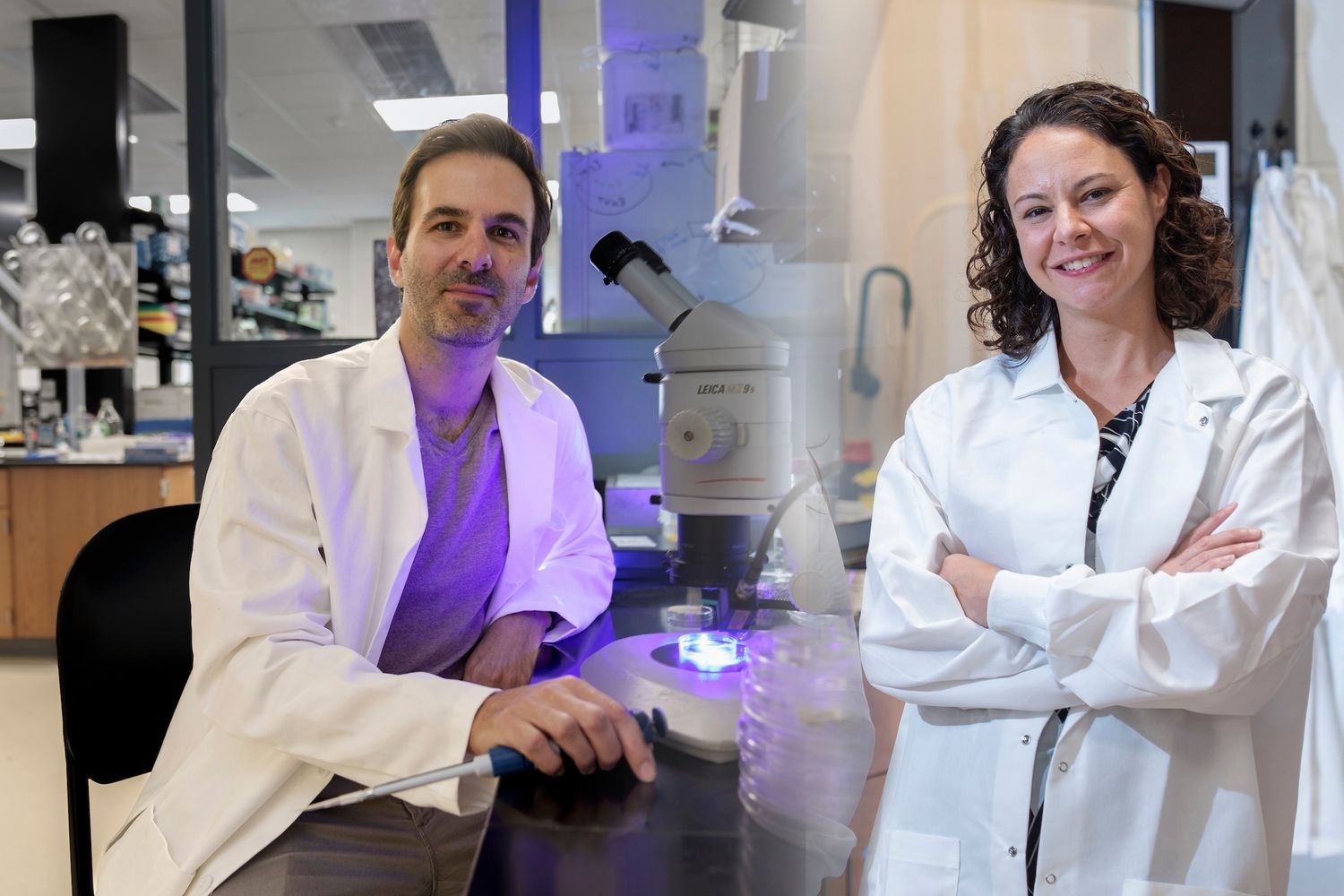
Photo: JeffJanowski/UNCW
Two UNC Wilmington researchers were selected for National Science Foundation (NSF) CAREER awards, among the Foundation’s most prestigious awards for early-career faculty. The awards support faculty who have the potential to serve as academic role models in research and education and to lead advances in the mission of their departments or organizations. Lori Schweikert and Jake Warner, associate professors from the Department of Biology and Marine Biology and affiliated with the Center for Marine Science, are the first UNCW recipients in nearly two decades.
The NSF Faculty Early Career Development (CAREER) Program has supported tens of thousands of early-career faculty since 1995 in advancing research and STEM education while contributing to discovery and workforce development. The program provides stable funding at a sufficient level and duration to enable awardees to develop as outstanding researchers and educators, while integrating research and teaching.
UNCW joins a short list of top universities in being awarded CAREER grants, including Duke University, Stanford University, UNC Chapel Hill, NC State University, Wake Forest University, Cornell University and Princeton University.
"The NSF CAREER program recognizes a combination of research excellence and educational leadership. Drs. Schweikert and Warner exemplify the teacher-scholar model that defines UNCW, where advances in discovery create new opportunities for student learning, and student engagement fuels new ideas and innovation. Receiving two CAREER awards in the same year reflects the growing national recognition of UNCW's research enterprise. It further supports how excellence in research strengthens the educational experience we provide our students," said Stuart Borrett, associate provost for Research and Innovation.
Of the 618 CAREER awards made to North Carolina researchers to date, a majority go to R1 institutions. UNCW is an emerging research institution, which points to the intellectual merit and quality of Schweikert and Warner's proposals.
Schweikert’s CAREER Project: “Investigating New Frameworks for the Physiology and Functional Significance of Dermal Photoreception in Dynamic Color Change”
Schweikert will address a long-standing question in sensory biology, asking how and why dermal photoreception – a light-detecting capacity of the skin – contributes to the rapid color changes used by animals for camouflage. Discoveries of photoreception in tissues outside the eye are far outpacing gains in the understanding of its significance. This work will close that gap, providing new insights into how dermal photoreception may differ from conventional understanding of photoreception by the eye.
The project will investigate the mechanisms behind whether the skin acts as a sensory system for monitoring the environment or the animal’s own coloration. By uncovering the principles underlying distributed light sensing and adaptive camouflage, the project may inform future technologies related to bioinspired sensing, imaging and autonomous materials. It aims to attract and train the next generation of integrative biologists by combining original research experiences with commercialization training, as well as strategic opportunities in professional development. The project was awarded $686,821 in NSF funding.
"Any success like this is a reflection of a much larger community of people who believe in a shared vision and worked to see that vision realized. In many ways, this award belongs to that community, and I look forward to seeing its impact at UNCW through new opportunities in education and research for years to come," Schweikert said.
Warner's CAREER Project: "Uncovering the Gene Regulatory Networks of Coral Skeleton Development"
Warner’s project will establish new models and methods for studying coral development and provide the first in-depth analysis of gene regulation and cell specification in corals. Coral reefs are home to one-quarter of marine biodiversity and are invaluable ecological, economic and cultural touchstones of the world’s oceans. Despite this importance, corals remain one of the most poorly studied organisms from a developmental perspective.
The project will address this gap in understanding coral development, with potential impacts in coral biology and restoration as coral reefs are increasingly threatened. “In short, we’re trying to understand how corals grow from the earliest life stages to better understand the keys to successful coral growth and reproduction,” Warner noted.
"The idea to study early coral development began right here at UNCW as a collaboration with Dr. Nikki Fogarty, who leads one of the few labs in the world able to spawn corals in captivity, providing an unprecedented opportunity to study their development," said Warner. "After early successes, made possible by the efforts of outstanding undergraduate and graduate student researchers, the project grew with seed funding from Research and Innovation and the NC Biotechnology Center."
Warner continued, "this CAREER award truly reflects the supportive and enriching environments for high-impact research here at UNCW, the Center for Marine Science and the Department of Biology and Marine Biology."
Workforce development efforts focused on supporting transfer students at UNCW through the First-Year Research Experience (FYRE), a marine genomics course-based undergraduate research experience and a career readiness symposium are initiatives included in Warner's work. The project was awarded $841,721 in NSF funding.