

Jay Styron ’90
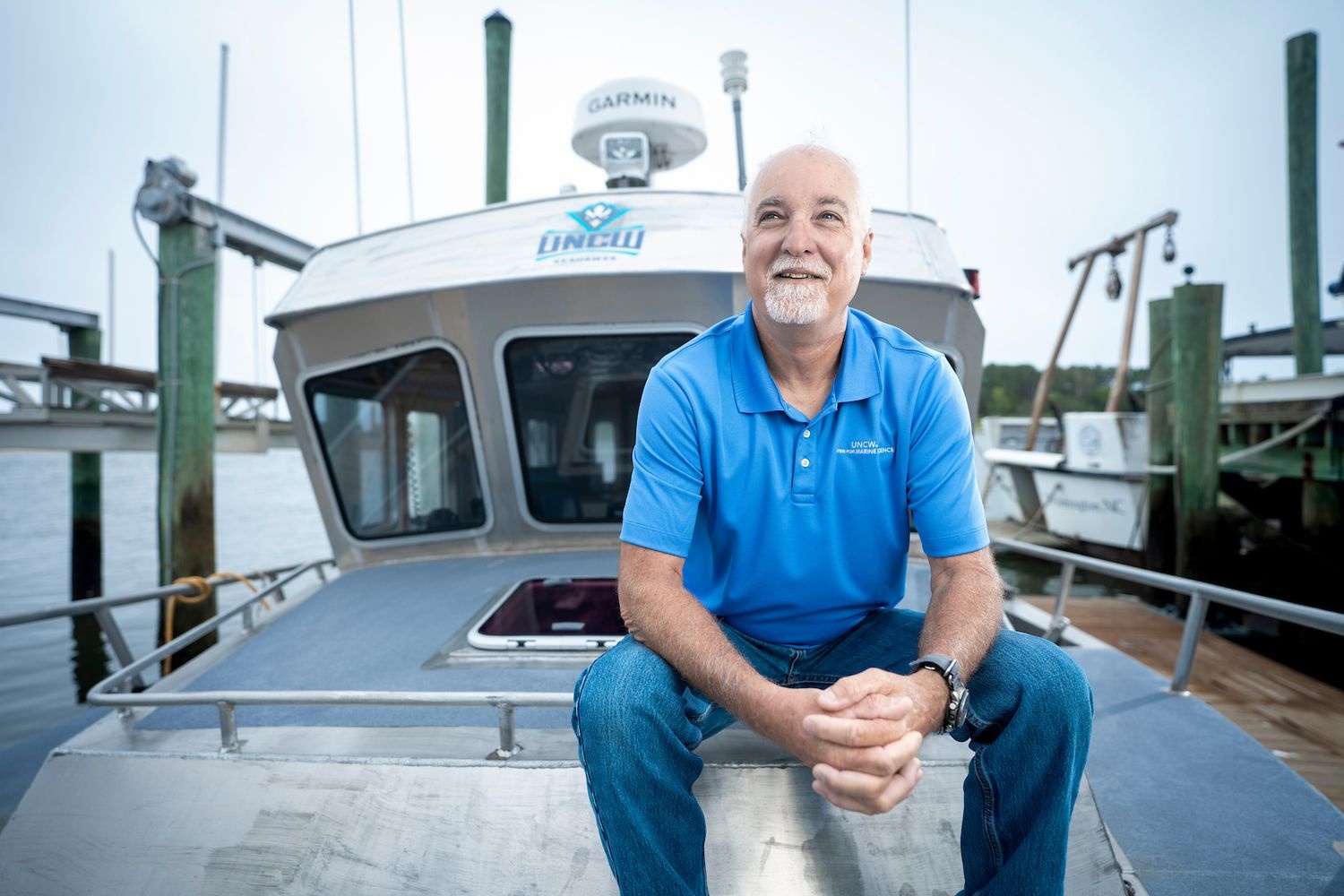
Photo: Jeff Janowski/UNCW
Inspired by oceanographer Jacques Cousteau and guided by a family legacy of mariners, Jay Styron ’90 pursued a career that blends science with exploration.
“Many generations of my family have lived and worked on the coast and have been shaped by it,” said Styron, associate director of marine operations at the Center for Marine Science. “I would like the coast and its waters to be like they were when I was growing up, but I realize they can’t. Hopefully, what I do will help the small pieces that remain relatively unchanged.”
For more than three decades, Styron has helped shape how UNCW researchers explore the ocean. He oversees the university’s marine research fleet and supports scientific missions, manages vessel operations, coordinates research activities, supervises marine technicians and captains, and ensures that the fleet is properly equipped for tasks such as geophysical surveys and biological studies.
His responsibility grew even larger with the addition of UNCW’s new 78‑foot research vessel, R/V Osprey, a ship Styron helped design. Working with All American Marine and CMS leadership, he navigated a process that was far more intricate than he expected. The vessel is outfitted with advanced labs and state-of-the-art marine technology.
“This will be a floating multidisciplinary lab, classroom and research space that will be totally unique for the university,” he said. “It will also carry UNCW's name up and down the East Coast.”
Styron’s passion extends well beyond the UNCW campus. In 2006, he and his wife founded Carolina Mariculture Co. on Cedar Island in North Carolina.
“Growing up on Cedar Island, oysters were a big part of the fall and winter, and I knew how people liked our wild oysters, so this all kind of fell together,” he said. “Around this time, commercial fishing in North Carolina was facing a severe downturn, and I wanted to show local fishermen that there was something they could do to stay on the water and use many of the skills and resources they already had.”
He has also lent his expertise to organizations like NC Catch and the East Coast Shellfish Growers Association, helping steer conversations about the future of responsible seafood production.
“I’m hoping our politicians and regulators will realize that not everything has a price tag on it, and some things are lost forever once they’re gone,” Styron said.
After decades in the field, the ocean still fuels his sense of purpose. Styron says his motivation comes from sharing what he’s learned with the next generation.
“Knowing how important the ocean, rivers and estuaries are to the health of the coast and being able to show others how to work in these challenging environments keeps me inspired,” he said.
“My hope is that the new vessel will be the start to make this university the true leader in marine and coastal science in NC and the US,” Styron added. “With our university and marine science center located on the shores of the ocean, estuary and river we have an obligation to make these our priorities.”