

|

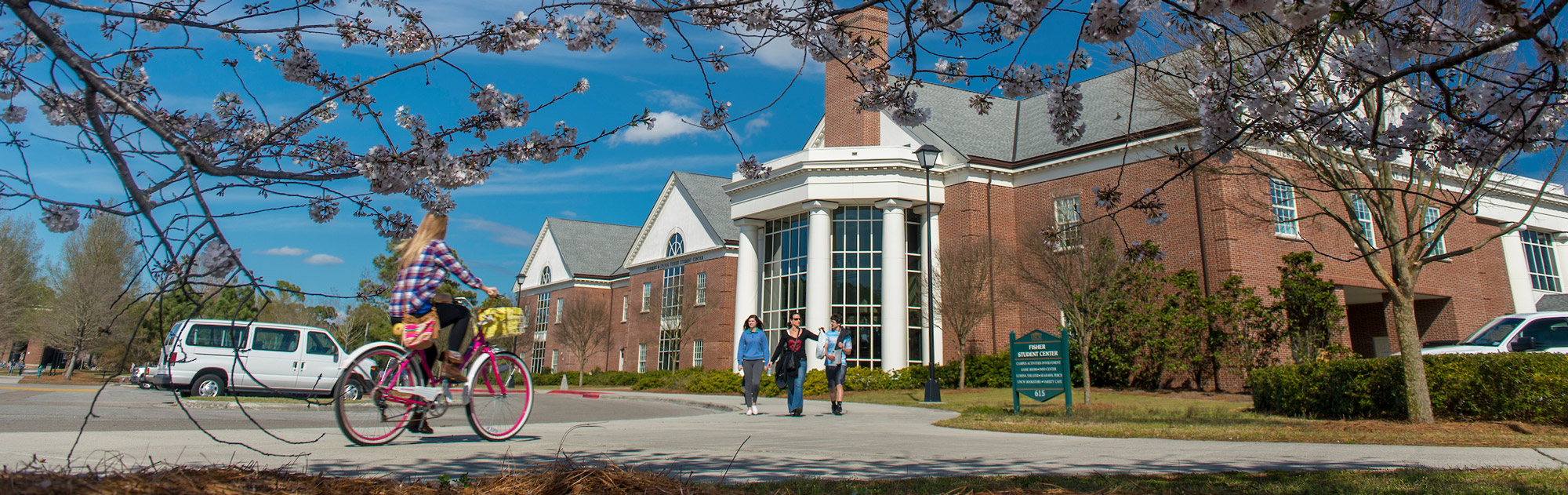
Additional seating nodes and garden development are recommended at building entries
along the Chancellor's Walk.

View across pond from amphitheater in Campus Commons.

View to Wagoner Hall where native plantings are recommended.
|
4. Academic Core
Character
As the nucleus of the Arboretum, the Academic Core is the central garden zone within
the campus which extends from Randall Library along the Chancellor's Walk to Wagoner Hall.
The classroom buildings within this zone provide the opportunity for individual thematic
gardens of a highly cultivated nature. Each end or terminus of the Chancellor's Walk will
have a landscape sub-zone with emphasis upon native species and their use in the
contemporary landscape. The linear configuration of the Chancellor's Walk should be
modified with various planting arrangements which create spaces and rooms acknowledging
formal connections to the buildings' entries. Each building has an opportunity for a
thematic garden with a focus or emphasis pertaining to a main plant genus and its
supporting cast of species and cultivar plant material, i.e., Magnolia collection. This
thematic approach will allow for the highly cultivated landscape to present itself through
collections of hybrid plants and exceptional cultivars.
Recommendations
Academic Core
- Each building should have a garden room at its entry. This garden will support
educational opportunities for classroom instruction and will display collections of
significant plant families. These spaces should accommodate 30 to 40 students.
- These garden rooms, as well as other nodes along the walk, should provide
"interruptions" in the linearity of the Chancellor's Walk. Brick paving nodes
with seat walls will provide variety and contrast to the existing concrete walk.
- The majority of the existing line of Crape Myrtles in the center of the Chancellor's
Walk should be relocated to other garden zones (i.e., residential areas). This central
zone should then be filled in with brick or stone. A study should be performed to see if
the existing light poles in the center of the walk should also be relocated.
- Seating opportunities should be created along the walk edges as much as possible.
Additional pavement off the Chancellor's walk with the addition of benches and shade trees
will provide seating nodes and gathering spaces.
- Access to the Chancellor's Walk is presently occurring through the wooded area across
from the new Science Building. A boardwalk pathway through this low, natural area should
be explored for it provides a pleasant, naturalistic setting for seating and gathering
opportunities.
- A standard group of site furniture should be selected for this area, as well as the
entire campus, to provide visual continuity.
- A concerted effort should be made to screen views to the parking lots fronting the
Chancellor's walk. A composition of evergreen hedges and small trees around their
perimeter would buffer views to cars and pavement. Consideration should be given to moving
the large "S" and "T" lots. These lots represent favorable locations
on the Chancellor's Walk for future buildings and garden development.
- Thematic gardens to consider for this area include:
- Butterfly Garden
- Plant Pollinator Garden
- Medicinal Herb Garden
- Healing Garden
- Fragrance Garden
- Suggested plant collection gardens:
- Crape Myrtles
- Camellias
- Dogwoods
- Ornamental grasses, sedges and rushes
- Bamboos
- Tropicals
- Daylilies
Campus Commons
- This area should continue to encourage relaxation, casual recreation and social
gatherings. Large tree groves are important for shade and definition of space, especially
at the outdoor amphitheater area.
- The garden space should present naturalistic placement of native plants with emphasis on
coastal wetland species. A balance of trees, shrubs, ground covers and lawn will enhance
the ponds which are the focal point of the garden.
- Sweeping, curvilinear plant beds of shrubs, grasses, and perennials should flow in and
around the pond's edge and sidewalks. Plants at the pond's edge should be selected to
control the erosion which is occurring here.
- Plant material selection should support birds and wildlife and provide nesting habitats
for waterfowl. Placement of appropriate bird houses should occur near the pond.
- A study should be performed to determine if the Arboretum Visitor Center should be
located adjacent to the Commons. Walking tours could originate from the Center and easily
continue into the Preserve, Conservation areas and other areas of the campus.
Wagoner Hall
- Planting concepts should represent a continued assemblage of species native to North
Carolina Coastal areas.
- Upland species of plant types should be planted in groves. Representative colonies of
various pines, oaks and magnolias can be displayed here.
- Interpretives for the native pine savannah grasses are important here. Stands of these
grasses have begun growing naturally under the pine trees.
- The cultivated gardens near the building courtyards can display a variety of the more
ornamental native trees like Magnolias, Buckeyes, Serviceberry and Fringe Trees. This
formal arrangement of ornamental natives will educate the visitor on their use and
strength in a traditional garden arrangement.
Maintenance
A high level of maintenance will be necessary for the individual gardens along the
Chancellor's Walk. These gardens will present various plant collections and maintenance of
these collections will become an important demonstration and educational tool.
The native plant pallets in the Commons and at Wagoner Hall will require a moderate
level of maintenance. Lawns will become secondary to the gardens and plant beds.
Issues
- Plants along the Chancellor's Walk which are part of the Thematic Gardens should be
monitored closely. Any declining or diseased plants will need to be moved out of the
gardens promptly.
- Plant identification and interpretives are important for this garden zone. Botanists,
plant collectors, as well as residential gardeners, will study these areas.
- In the Commons, care should be given to the plants near the ponds so that little, if
any, fertilizers or chemicals pollute the water. Algae build-up will result and is very
unsightly. Grass mowing should not occur near the water's edge. Shade trees at the pond's
edge will also help to control algae growth.
- Limited pruning and mulching will occur in the more naturalized plant beds in the
Commons and near Wagoner Hall. Native grasses should help to reduce the expanse of
manicured lawns. The beauty of native plants should be emphasized here.
Plant Palaette
Campus Commons
Shade Trees
Acer rubrum/Red Maple
Betula nigra 'Heritage' or 'Dura-Heat'/River Birch
Liquidambar styraciflua 'Rotundiloba'/Fruitless Sweetgum
Taxodium ascendens/Pondcypress
Taxodium distichum/Baldcypress
Nyssa sylvatica/Black Gum
Evergreen Trees
Ilex opaca/American Holly
Ilex vomitoria/Yaupon Holly
Pinus taeda/Loblolly Pine
Pinus palustris/Longleaf Pine
Pinus virginiana/Virginia Pine
Ornamental Trees
Aesculus pavia/Red Buckeye
Amelanchier arborea/Downy Serviceberry
Aronia arbutifolia/Red Chokeberry
Chionanthus virginicus/Fringe Tree
Magnolia virginiana/Sweetbay Magnolia
Persea borbonia/Red Bay
Prunus serotina/Black Cherry
Shrubs
Callicarpa americana/American Beautyberry
Cephalanthus occidentalis/Buttonbush
Clethra alnifolia/Sweet Pepperbush
Ilex glabra 'Compacta'/Compact Inkberry
Itea virginica/Virginia Sweetspire
Lonicera sempervirens 'Major Wheeler'/Coral Honeysuckle
Lyonia lucida/Fetter Bush
Herbaceous Plants for Pond Edge
Boltonia asteroides 'Snowbank'/Boltonia
Chelone lyonii 'Hot Lips'/Pink Turtlehead
Chrysogonum virginianum var. australe/Green and Gold Plant
Coreopsis verticillata 'Moonbeam'/Moonbeam Coreopsis
Echinacea purpurea 'Magnus'/Purple Coneflower
Equisetum hyemale/Horsetail
Eupatorium fistulosum 'Selection'/Compact Joe Pye Weed
Helianthus angustifolia 'Mellow Yellow'/Pale Yellow Swamp Sunflower
Hypericum frondosum 'Sunburst'/Native Golden St. John's Wort
Iris fulva/Copper Iris
Iris pseudacorus/Yellow Flag Iris
Iris versicolor/Blue Flag Iris
Oenothera tetragona 'Summer Solstice'/Sundrops
Tiarella cordifolia 'Slickrock'/Foamflower
Tradescantia 'Purple Profusion'/Spiderwort
Typha latifolia/Cattail
Grasses/Ground Covers
Andropogon virginicus/Broom Sedge
Carex plantaginea/Plantain Sedge
Dichromena latifolia/White-Bracted Sedge
Panicum virgatum/Switch Grass
Schizachyrium scoparium/Little Bluestem
Wagoner Hall
Shade Trees
Pinus palustris/Longleaf Pine
Ulmus alata/Winged Elm
Quercus coccinea/Scarlet Oak
Quercus incana/Bluejack Oak
Quercus marilandica/Blackjack Oak
Quercus stellata var. margaretta/Sand Post Oak
Quercus virginiana/Live Oak
Ornamental Trees
Aesculus pavia/Red Buckeye
Cercis canadensis/Eastern Redbud
Cornus florida/Dogwood
Magnolia acuminata/Cucumber Magnolia
Magnolia grandiflora/Southern Magnolia
Magnolia macrophylla/Bigleaf Magnolia
Sassafras albidum/Sassafras
Vaccinum arboreum/Sparkleberry
Grasses
Andropogon virginicus/Broom Sedge
Aristida stricta/Wire grass
|