


Ulku Clark
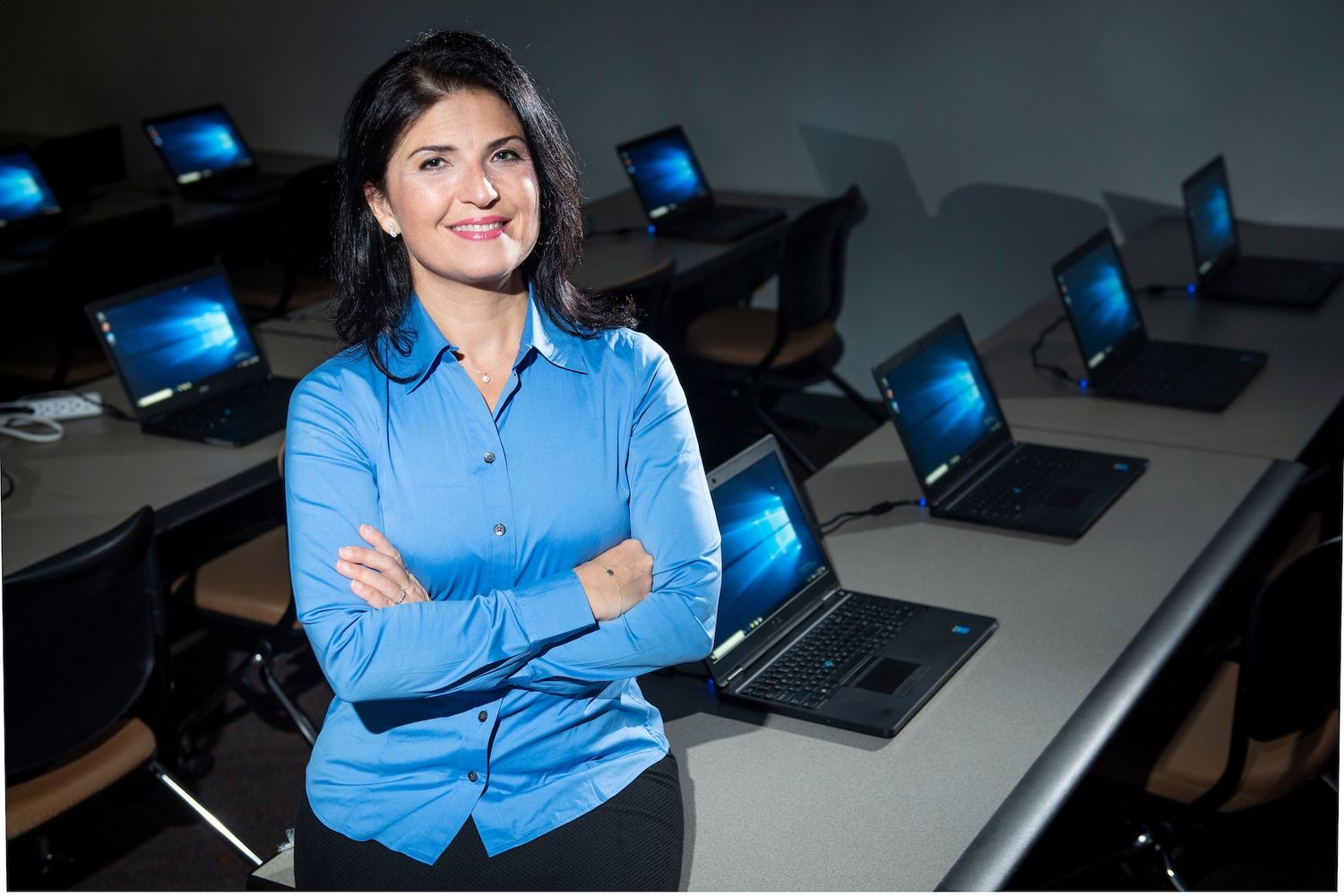
Photo: Jeff Janowski
Protecting the ports one cyber threat at a time, Ulku Clark remains a leader in maritime cybersecurity for the Port of Wilmington and beyond.
Clark grew up in Türkiye and came to the United States for graduate school. For over 22 years, she has served the Seahawk community as a professor of cybersecurity and information systems in UNCW's Cameron School of Business and the director of the Center for Cyber Defense Education (CCDE).
Clark also leads several cybersecurity research, education and workforce development initiatives, including the Maritime Cybersecurity Applied Research, Technology and Education Center (MCARTEC) and Cyber Clinic.
“Maritime cybersecurity became a particularly natural area for UNCW. We are located in a coastal community with a major port, a strong marine science center and growing expertise in cybersecurity. It became clear that UNCW had an opportunity to build something distinctive at the intersection of these strengths,” said Clark, MCARTEC’s principal investigator.
MCARTEC serves the greater Wilmington community by strengthening the maritime subsector responsible for 95% of the cargo entering the United States, which accounts for approximately 25% of the nation’s GDP.
UNCW is located near the Port of Wilmington, which plays an important role in the military and the U.S. economy.
“I want students to understand that cybersecurity is not only about protecting computers and data. Increasingly, cybersecurity is about protecting systems that the physical world depends upon, such as transportation, ports, vessels, energy, manufacturing, communications and other critical infrastructure,” Clark said.
UNCW hosts an annual Cybersecurity Conference which brings students, faculty, government, industry and community members together on campus to discuss emerging cybersecurity challenges. These relationships often lead to internships, research collaborations, guest speakers, student projects and new ideas. This year’s conference is scheduled for Oct. 8–9.
Clark also revealed the exciting future of maritime cybersecurity. Through MCARTEC, research capabilities are being developed that allow faculty and students to study maritime cyber-physical systems in realistic environments. These include bridge and other simulation capabilities, navigation and communication technologies, operational technology and maritime networking environments.
“We are also moving into the next phase of our maritime cybersecurity research. Our technology-road mapping work identified 44 research and development areas and 153 research questions, giving us a foundation for a longer-term research agenda. We are now pursuing projects with industry and government partners that translate those research priorities into practical work,” she said.
On the education side, UNCW is launching a graduate-level Critical Infrastructure Cybersecurity Certificate with a maritime cybersecurity focus beginning in spring 2027. This will help serve not only traditional students but also professionals who need specialized cybersecurity education related to operational technology and critical infrastructure.
“We are also continuing to expand experiential learning through the Cyber Clinic, internships, research assistantships, cyber ranges and laboratories, simulations, tabletop exercises, hackathons, and capture-the-flag competitions,” Clark said.
MCARTEC is currently a finalist for the NC Tech Award in Public Sector Innovation.
“My hope is that UNCW becomes recognized not only for educating excellent cybersecurity professionals, but also as a place where organizations come to collaborate on some of the most difficult emerging cybersecurity challenges, particularly those involving maritime systems and critical infrastructure.”