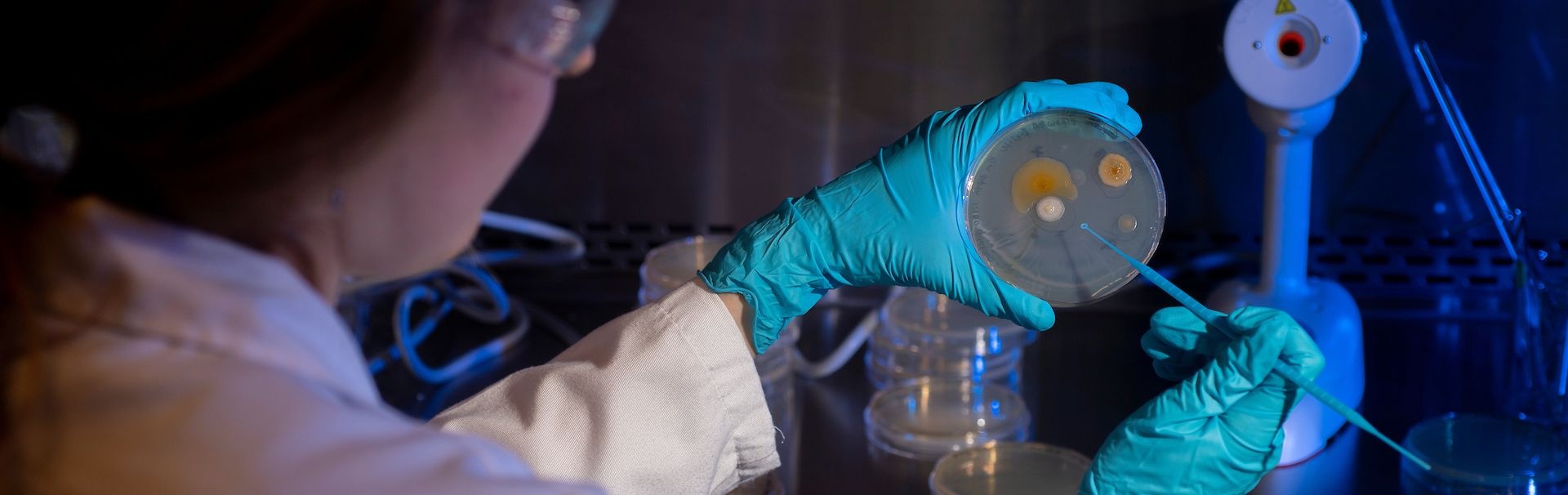

Our research involves the study of the ecology,
taxonomy and molecular biology of marine bacteria and Archaea. The
microorganisms that we have concentrated on are the members of the
genus Vibrio, species of which cause disease in human as well as
marine animals. Previous work in our lab has examined the distribution
of pathogenic Vibrio spp. in the coastal environment, the distribution
and role of plasmids in marine bacteria and the ecology of luminescent
Vibrio spp.
Current projects ongoing in our lab included the study of the association
of bacteria with toxic algal blooms and the examination of bacteria
bound to particulate material for the present of novel antimicrobial
substances. We use the technique of fluorescent in situ hybridization
(FISH) to examine bacteria collected from the environment. Using
this technique we have found the Archaea long thought to be extremophiles
are instead abundant in local water. Furthermore these Archaea may
have been culture for years and misidentified as bacteria.
Sizemore, R. K., and R. R. Colwell. 1977. Plasmids carried by antibiotic-resistant
marine bacteria. Antimicrob. Agents Chemother., 12:373-382.
Sizemore, R. K., J. J. Caldwell and
A. S. Kendrick. 1990. An alternate gram staining technique using
a fluorescent lectin. Appl. Environ. Microbiol. 56: 2245-2247.
E. C. Esham and R. K. Sizemore. 1998. Evaluation of two techniques:
mFC and mTEC for determining distributions of fecal pollution in
small North Carolina tidal creeks. Water, Air and Soil Pollution.
106: 179-197.
Mallin, M. A., L. B. Cahoon, R. P. Lowe, J. K. Merritt, R. K. Sizemore
and K. E. Williams. 2000. Restoration of shell fishing waters in
a tidal creek following limited dredging. J. Coastal Management
16:40-47.
Shehane, S. D. and R. K. Sizemore. 2002. Isolation and preliminary
characterization of bacteriocins produced by Vibrio vulnificus.
J. Applied Microbiology 92: 322-328.
|